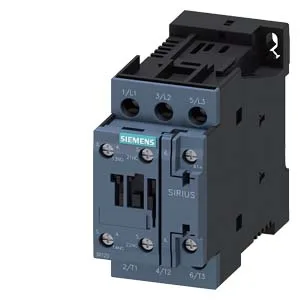
It's a current-production part, so no hunting for NOS or surplus — it's a standard catalog line. Main contacts rated 16 A down to 8 A, and it carries an auxiliary switch built in — saves a slot on the DIN rail if you need a feedback signal.
The AC-3 motor switching rating is what matters for most conveyor, pump, and fan duty. At 230 V it's rated 2 hp, and at 400 V it handles 3 A in AC-15 control-circuit duty. For DC switching at 24 V it's good for 10 A — that's the inductive load curve on solenoids or brake coils. Electrical life depends on the duty class: AC-3 gives you 1,000 operations per hour max, AC-4 drops to 300 per hour because of the harder breaking. If you're jogging or inching a motor, keep the AC-4 cycle rate in mind.
It's a common footprint — if you're swapping a failed contactor in a panel, the DIN rail clips and terminal layout are standard for this class. Auxiliary terminals take 2x (0.5 to 1.5 mm²) or 2x (0.75 to 2.5 mm²). All screw-type — no special tooling needed on site. That's the minimum to maintain rated isolation — tight panels can squeeze it, but don't crowd the arc chute side. Arcing time is 10 to 10 ms — consistent, not a wide spread. That's the kind of number that matters if you're coordinating fuse or breaker curves downstream.