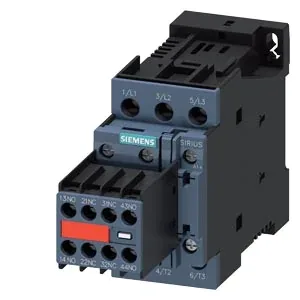
It mounts on 35 mm DIN rail per DIN EN 60715 via screw or snap-on fastening, with a +/-180° rotation range on vertical surfaces and +/-22.5° tilt allowance — flexible for tight enclosures. The coil is rated 24 VDC, and the main contacts handle 6 A at 24 VDC (DC-13 duty), with lower ratings at higher voltages: 2 A at 48/60 V, 1 A at 110 V, 0.9 A at 125 V, 0.3 A at 220 V, and 3 A at 400 V. Mechanical life is 10 million operations typical; electrical life at AC-3 duty is 1,000 cycles per hour maximum, dropping to 300 cycles per hour for AC-4 (plugging/inching). The arcing time is 10 ms, and the dropout time at DC is 15–18 ms — tight enough for sequenced starter schemes.
Dimensions: 85 mm high, 45 mm wide, 151 mm deep. That 151 mm depth is the dimension to watch when the gland plate is tight — it's the longest axis and the one that catches panel builders off guard. Main contact terminals accept solid or stranded wire from 1 to 10 mm²; auxiliary contact terminals accept 2x (0.5 to 1.5 mm²) or 2x (0.75 to 2.5 mm²). All are screw-type terminals — no spring-cage option on this variant. The contactor has no built-in auxiliary switch, so add a separate auxiliary contact block if you need feedback or interlocking. The 0.8 initial value and 1.1 full-scale value likely refer to coil operating voltage tolerance (80% to 110% of rated 24 VDC) — standard for SIRIUS contactors.