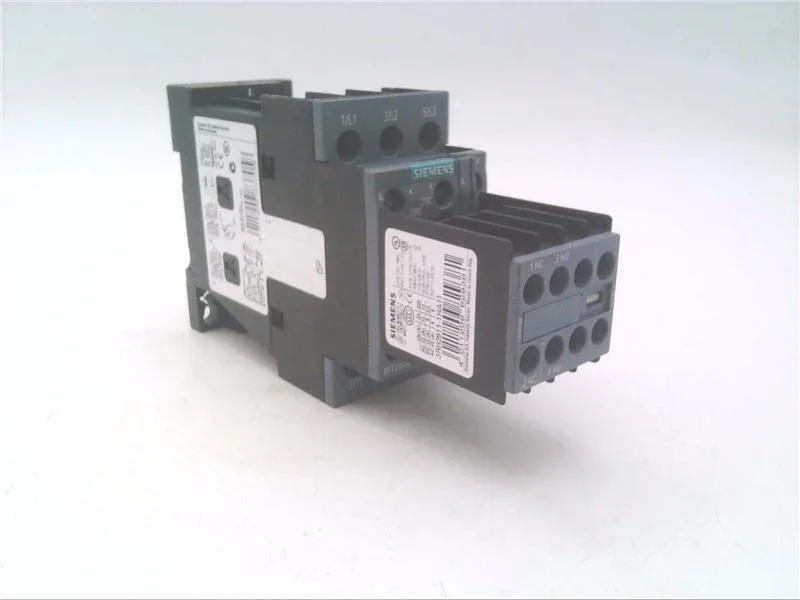
SIRIUS S0 Contactor with 24 V DC Coil
The Siemens 3RT2024-1BB44 is a SIRIUS-branded power contactor in the S0 frame size, designed for switching motor loads and resistive loads in industrial control panels. It carries a 24 V DC coil with screw-type terminals, and mounts via screw or snap-on onto 35 mm DIN rail per DIN EN 60715 — the standard panel integration for this class. Rated for 1,000 switching cycles per hour in AC-1, AC-2, and AC-3 duty, and 300 cycles per hour in AC-4 duty — the AC-4 ceiling matters for plugging or inching applications where the contactor makes and breaks under load more frequently.
Mounting and Clearance Constraints
Dimensions are 85 mm height, 45 mm width, and 151 mm depth — the 45 mm width fits a standard 2-module DIN-rail footprint, so it occupies two 22.5 mm slots in the enclosure. Minimum clearance around the contactor: 10 mm upwards, 10 mm forwards, 10 mm downwards, and 6 mm at the sides — these spacings must be maintained for heat dissipation and arc quenching. Mounting position allows +/-180° rotation on a vertical surface and can be tilted forward/backward by +/-22.5°, giving flexibility in tight cabinets where the contactor must sit at an angle.
Wiring and Connection Details
Main contact terminals accept solid or stranded wire from 1 to 10 mm², and auxiliary contact terminals accept 2x (0.5 to 1.5 mm²) or 2x (0.75 to 2.5 mm²) — the dual-wire entry is useful for daisy-chaining control signals without a separate terminal block. The coil connection uses screw-type terminals — no push-in or spring-cage option on this variant, so expect a screwdriver for termination. Arcing time is 10 to 10 ms — a tight window that limits contact erosion during break, relevant for applications with frequent switching near the rated current.
Environmental and Lifecycle Status
Operating temperature range is -25 to +60 °C, with storage from -55 to +80 °C — the wide storage range means it can sit in an unheated warehouse or on a truck in winter without issue. Mechanical service life is 10 million operations typical — this is the contactor body itself, not the contacts under load; electrical life depends on the switching duty and load current.