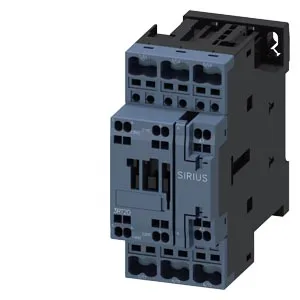
The 3RT2025-2AV00: The headline motor-switching rating is 14 A at 480 V in AC-3 duty — that's the current it can make and break for a standard squirrel-cage induction motor. AC-3 is the category for starting and stopping motors under load, so this contactor is sized for a motor drawing up to 14 A at 480 V. The auxiliary switch is present and rated at 10 A at 24 V, 2 A at 48 V and 60 V, and 1 A at 110 V — these are the contact ratings for the built-in aux contacts, so they can handle typical PLC-level signals or small relay coils directly.
Integration & Wiring
The coil connection uses spring-type terminals — that's the "2AV00" suffix telling you it's the spring-cage version for the coil, not screw terminals. Auxiliary contacts take 2x (0.5 to 2.5 mm²) solid or stranded.
Switching Frequency & Duty
Maximum switching rate for AC-1, AC-2, AC-3, and AC-3e duty is 1,000 operations per hour. For AC-4 duty (plugging, inching, reversing under load), the rate drops to 300 operations per hour. Arcing time is listed at 4 to 16 ms at AC, and a specific value of 0.25 ms at 50 Hz.