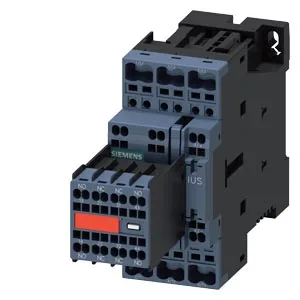
The 24 VDC coil picks up at 80% of rated voltage (19.2 V) and drops out at 110% (26.4 V), so it holds through a sag but releases cleanly on a brownout. Rated for 3 hp at 230 V motor duty — that's the AC-3 rating that governs real motor switching, not the higher AC-1 resistive current. DC load switching is specified per voltage: 10 A at 24 V, 2 A at 48 V and 60 V, 1 A at 110 V, 0.9 A at 125 V, 0.3 A at 220 V, and 3 A at 400 V — these are the numbers that matter for a DC bus or battery circuit, not the AC motor rating. Mechanical life is 10 million cycles typical; electrical life depends on the load, but the contactor is rated for 1000 operations per hour under AC-1, AC-2, AC-3, and AC-3e duty, and 300 ops/h under the heavier AC-4 plugging/reversing duty.
Panel fit and wiring — S0 frame, spring terminals, clearances
The S0 contactor measures 45 mm wide, 102 mm high, and 154 mm deep — a standard footprint that fits alongside other SIRIUS S0 gear on a 35 mm DIN rail per DIN EN 60715, using either screw-fixed or snap-on mounting. Spring-type terminals accept solid or stranded copper from 1 to 10 mm² on the main contacts, and 2 × (0.5 to 2.5 mm²) fine-stranded with ferrules on the coil terminals — no screw tightening, which speeds panel wiring. Clearance requirements: 10 mm upwards, 10 mm downwards, 10 mm forwards, and 6 mm at the sides — tight enough for dense DIN-rail layouts, but the 154 mm depth means the contactor projects well into the enclosure, so leave enough door clearance.
Lifecycle and sourcing — current production, no auxiliary contacts
Note that this variant ships without an auxiliary switch block (auxiliary switch: no), so if your circuit needs a feedback contact or a status signal to a PLC, you'll need to order a separate auxiliary contact block that clips onto the S0 contactor.