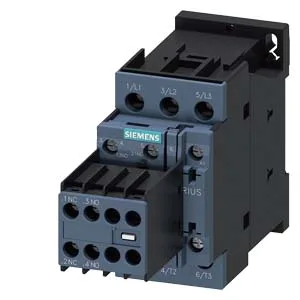
Rated for 3 hp at 230 V, it handles typical induction motor starting duty. The mechanical endurance is listed at 10,000,000 cycles typical, which means it outlasts most panel builds before a swap is needed.
The AC-3 switching frequency is 750 operations per hour maximum. That's the motor-starting duty cycle — if your line cycles faster than every 4.8 seconds, this contactor will overheat. For resistive loads (AC-1), it can handle 1,000 ops/h; for plugging or inching (AC-4), it drops to 250 ops/h. Breaking current varies by voltage: 6 A at 24 V, 3 A at 400 V, and 21 A at 480 V. The 480 V figure is the highest on the list — that's the worst-case arc interruption the contacts are rated to clear. At 230 V, the motor horsepower rating of 3 hp gives a quick cross-check for North American panel specs. The coil uses screw-type terminals — no spring-cage here, so factor in screwdriver torque time during assembly. No auxiliary switch is built in, so if you need feedback, plan on a separate aux block.
That's tight — you can nest these on a DIN rail with 6 mm between contactors. Dimensions are 85 mm high by 45 mm wide by 141 mm deep. The S0 frame is a common size across the SIRIUS line, so panel cutouts and busbar kits for S0 transfer directly. That -55 °C storage floor matters for unheated warehouses in cold climates — the contactor won't crack, but let it warm before energizing.
If you're looking at a panel built around the 3RT2026-1AG20 (a sibling with different coil voltage or aux config), the mechanical footprint is identical — same S0 frame, same 45 mm width, same DIN rail clip. The swap decision comes down to coil voltage and whether you need the aux contacts that sibling carries.