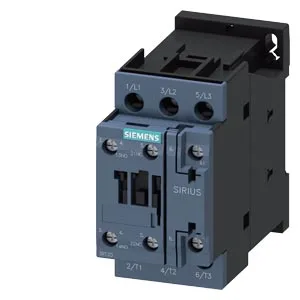
The contactor is rated for different switching frequencies depending on the duty class. At AC-1 (resistive loads) it handles up to 1,000 cycles per hour; at AC-2 and AC-3 (motor starting and running) it manages 750 cycles per hour; at AC-4 (plugging and inching) it drops to 250 cycles per hour. These numbers define the thermal capability of the contactor under repeated switching — exceeding them risks overheating the arc chamber or welding the contacts. For a conveyor drive cycling every 30 seconds, the AC-3 rating of 750/h means it can sustain that rate continuously. The auxiliary contact block is already integrated (Auxiliary Switch: Yes), with ratings from 10 A at 24 V down to 0.3 A at 220 V, covering PLC-level signals and relay logic. Coil holding power is 0.25 VA at 50 Hz and 0.28 VA at 60 Hz — a low burden on the control transformer. Operating time at AC is 4 to 16 ms, arcing time 10 ms, which is typical for this frame size and means the contactor clears faults fast enough for most motor branch circuits.
Installation clearances and environment
These gaps prevent arc flashover and allow heat dissipation. Electrical life depends on the load and switching frequency, so for a lightly cycled pump it may outlast the cabinet; for a frequent-start application, plan spares accordingly.