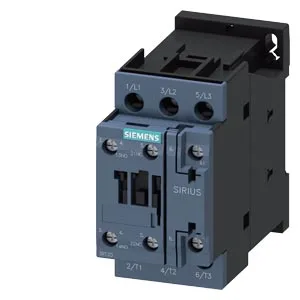
S0 frame size and panel fit
The 3RT2026-1AC20-ZW96: This frame class determines the mechanical interface for auxiliary contact blocks and the overload relay mounting — the S0 is the mid-range frame in the SIRIUS contactor family, sized for motor loads where a smaller S00 would be thermally marginal and an S2 would waste panel width. The depth dimension of 97 mm governs the enclosure depth needed — standard 120 mm deep enclosures clear this comfortably, but shallow 80 mm backboxes will not.
Wire termination and conductor sizing
For a 4 mm² motor feed, the terminal can take the conductor directly without ferrule — the screw clamp provides the contact force. The 1 mm² minimum matters when tapping control wiring from the same terminal; below that gauge the conductor may not clamp securely.
Switching frequency by duty class
The contactor's maximum switching rate varies by utilization category: 1,000 operations per hour in AC-1 (resistive loads), 750 ops/h in AC-2 and AC-3 (slip-ring and squirrel-cage motors), and 250 ops/h in AC-4 (plugging/inching duty). For a conveyor running at 30 cycles per hour under AC-3, the contactor is well within its mechanical endurance of 10 million operations typical — the electrical life at rated current will be the limiting factor, not the switching rate.
Auxiliary contact ratings across voltages
For a 24 VDC PLC input sinking 10 mA per channel, the auxiliary contact can drive multiple inputs in parallel without approaching its rated current. At 230 V control circuits, the 0.3 A rating limits the number of paralleled contactor coils the auxiliary can drive — a typical SIRIUS coil draws around 4 VA holding, so at 230 V that is roughly 17 mA per coil, allowing up to 17 coils before reaching the rating.
Environmental limits and storage
For a panel in an unheated warehouse that sees -20 °C overnight, the contactor starts and operates within spec — no heater required. The storage range covers most shipping and warehousing conditions without special climate-controlled handling.