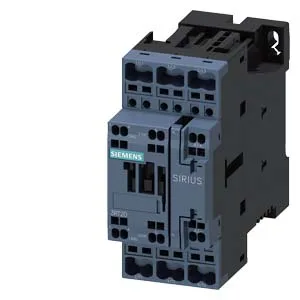
Siemens SIRIUS 3RT2026-2BB40-ZX95 — Power Contactor, Size S0, 24 VDC Coil
The Siemens SIRIUS 3RT2026-2BB40-ZX95 is a power contactor in the size S0 frame, designed for switching motor loads and resistive circuits in industrial control panels. It carries a 24 V DC coil rated at 10 A at 24 V, and the main contacts terminate via spring-type terminals — no screw torque to verify, just strip and insert. The contactor mounts on a 35 mm DIN rail per DIN EN 60715, using either the screw or snap-on method, and the mounting position allows ±180° rotation on a vertical surface plus ±22.5° tilt forward or backward, which gives flexibility in tight enclosures.
Key Ratings and What They Mean for Fit
The 24 V DC coil draws 10 A at rated voltage — that's the inrush at pickup, not the hold current, so size your 24 VDC supply for that peak. The contactor is rated for 10 A at 24 V, but the switching capacity varies with voltage: 2 A at 48 V or 60 V, 1 A at 110 V, 0.9 A at 125 V, 0.3 A at 220 V, and 3 A at 400 V. For motor loads, the AC-3 switching frequency maxes out at 750 operations per hour, while AC-4 (plugging/reversing) is limited to 250 per hour — important for high-cycle applications like conveyor indexing. Mechanical life is rated at 10 million operations typical, so this contactor is built for long service in moderate-duty cycles. The coil operates from -25 to +60 °C ambient, with storage from -55 to +80 °C. The DC operating time is 15 to 18 ms, and arcing time is 10 ms — fast enough for most control schemes but verify your PLC cycle time if you're sequencing multiple contactors. Clearance requirements are 10 mm upwards, forwards, and downwards, and 6 mm at the side — plan your DIN-rail layout accordingly.
Wiring and Termination
Spring-type terminals accept solid or stranded conductors from 1 to 10 mm², and for auxiliary contacts, 2x (0.5 to 2.5 mm²) solid or stranded. The contactor includes an auxiliary switch, which simplifies adding status feedback without a separate block. The main contact rating range is 18 to 8 A — that's the thermal continuous current range for the main poles, so size your overload relay accordingly.
