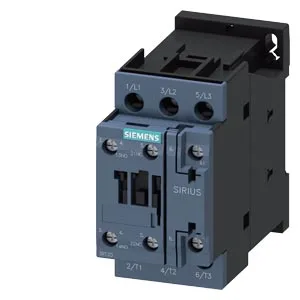
This contactor is rated for mechanical endurance of 10,000,000 operating cycles, which gives a baseline for maintenance intervals in high-cycle applications like conveyors or packaging lines. The switching frequency varies by duty: up to 1,000 cycles per hour for AC-1 resistive loads, 750 cycles per hour for AC-2 and AC-3 motor starting, and 250 cycles per hour for AC-4 plugging/reversing. The AC-3e rating also caps at 750 cycles per hour. These numbers tell you the contactor is built for moderate-speed cycling, not for high-speed jogging applications.
The built-in auxiliary switch carries rated currents that drop with voltage: 10 A at 24 V, 2 A at 48 V, 2 A at 60 V, 1 A at 110 V, 0.9 A at 125 V, 0.3 A at 220 V, 3 A at 400 V, and 0.6 A at 440 V. These are the contact ratings for the auxiliary circuit — use them to size the control transformer and verify the signal voltage drop across long cable runs. At 400 V the contact is rated for 3 A, which is enough for a typical PLC input or relay coil, but at 440 V it drops to 0.6 A, so check your load if the control voltage is on the high side.
Dimensions are 85 mm high, 45 mm wide, and 97 mm deep — the 45 mm width is a standard single-module footprint on 35 mm DIN rail, so it occupies one position. For the auxiliary contacts, it accepts 2x (0.5 to 1.5 mm²) or 2x (0.75 to 2.5 mm²). The magnet coil uses screw-type terminals. Arcing time is 10 ms, and clearance distances are specified: 10 mm upwards, 10 mm forwards, 10 mm downwards, and 6 mm to the side. These clearances matter when laying out the panel — you need that space for arc flash containment and heat dissipation, especially if the contactor is running near its thermal limits.