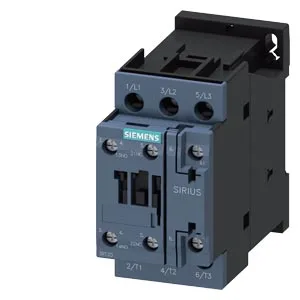
The S0 frame is the workhorse size for motor loads up to the mid-range — think pumps, fans, and small conveyors in a control cabinet.
Switching frequency tells you how hard you can work this contactor in a given duty. At AC-1 (resistive loads) it's rated for 1,000 operations per hour maximum. For AC-3 motor starting and AC-2 (slip-ring motor) duty, that drops to 750 ops/hr. AC-4 — inching or plugging — is the toughest: 250 ops/hr maximum. The AC-3e rating (enhanced motor switching) also sits at 750 ops/hr. If your application cycles faster than these limits, the contactor will overheat; these numbers define the thermal ceiling for the coil and main contacts. The auxiliary contact ratings are given for DC switching at various voltages: 10 A at 24 V, 2 A at 48 V and 60 V, 1 A at 110 V, 0.9 A at 125 V, 0.3 A at 220 V, 3 A at 400 V, and 0.6 A at 440 V. These are the maximum currents the auxiliary contacts can break at those DC voltages. If you're switching a PLC input or a relay coil at 24 VDC, you've got headroom to 10 A; at 220 VDC the limit drops to 0.3 A, so check your load before wiring. Wire range is 1 to 10 mm² solid or stranded for the main circuit, and 2x (0.5 to 1.5 mm²) or 2x (0.75 to 2.5 mm²) for the auxiliary circuit. That covers most panel wiring up to about 50 A class — you can land a 6 mm² motor feed without a ferrule adapter. The contactor measures 97 mm deep by 85 mm high by 45 mm wide, which slots into a standard S0 footprint on the rail.