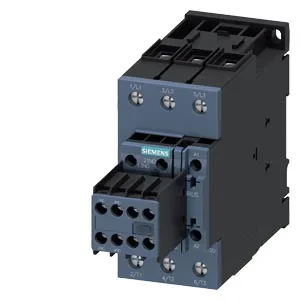
The coil accepts 20 to 33 V AC or DC, drawing 2 VA at both 50 Hz and 60 Hz, with an inrush current peak of 3 A. That 20-33 V range means it holds in on a nominal 24 V control supply and stays pulled in through dips down to 20 V — useful if your DC bus sags under heavy load.
The S2 frame carries the main contact rating for this class. The contactor is sized for typical motor switching duty; the operating cycles per hour vary by duty class: up to 1 000 cycles/h at AC-1 (resistive), 800 cycles/h at AC-3 (squirrel-cage motor starting), and 250 cycles/h at AC-4 (plugging/inching). For a conveyor or pump starting under AC-3, the 800 cycles/h ceiling is generous enough for most cyclic applications. Main contact configuration is 3-pole, with 1 normally open and 1 normally closed auxiliary contact built in (18 to 1 numbering). No separate auxiliary switch block is needed for basic feedback — the integrated aux pair handles status indication to a PLC input. Wire termination uses screw-type terminals on the coil and main contacts, accepting 2 x (0.5 to 1.5 mm²) or 2 x (0.75 to 2.5 mm²) solid or stranded. That covers common control and power wiring sizes without needing pin ferrules, though ferrules are fine for stranded. Dimensions are 55 mm wide, 114 mm high, and 174 mm deep. The 55 mm width is a single modular unit on a DIN rail — it occupies one standard slot, so panel space budgeting is straightforward.
The closest functional peer within the same SIRIUS S2 family is the 3RT2037-1AF00-ZX95, which shares the same frame size and mounting footprint. The primary difference is the coil voltage — the 3RT2037-1AF00-ZX95 uses a different coil range. If your control voltage is fixed at 24 V DC, the 3RT2036-1NB34 with its 20-33 V coil is the direct fit; the 3RT2037 variant would require a coil voltage check before substitution.