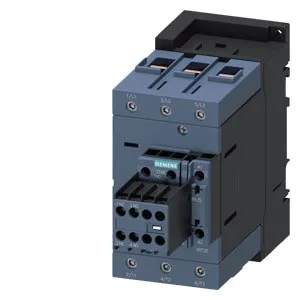
The 24 VDC coil is controlled via screw-type terminals, and the contactor includes an integrated auxiliary switch for status feedback or interlocking. The contactor accepts a wide conductor range — solid from 2.5 to 16 mm² and stranded from 6 to 70 mm² for the main circuit — which covers most panel wiring from control to power distribution.
Duty-cycle capability — the number that governs real use
The headline switching frequency varies by duty class: 900 cycles/h at AC-1 (resistive), 850 at AC-3 (standard motor start/run), 350 at AC-2 (slip-ring motor), and 200 at AC-4 (plugging/inching). For most conveyor, pump, and fan applications, the AC-3 rating of 850 cycles/h is the practical limit — it tells you the contactor can handle frequent starts without overheating the arc chamber. The auxiliary contact ratings are specified per voltage: 6 A at 24 V DC, 2 A at 48 V DC, 1 A at 110 V DC, 0.9 A at 125 V DC, 0.3 A at 220 V DC, and 3 A at 400 V AC. These are the maximum switching currents for the auxiliary circuit — important when feeding PLC inputs or pilot lights.
The contactor measures 70 mm wide, 140 mm high, and 195 mm deep.