The auxiliary contact ratings cover the common control voltages you'll see on a lube skid or conveyor line: 10 A at 24 V, 10 A at 230 V, 3 A at 400 V, and 0.1 A at 600 V. The mechanical life is listed at 10 million operations typical, so this contactor will outlast the motor it's switching on most cyclic loads. If your panel sits next to a hot bearing housing or a steam line, the -25 to +60 window covers most plant-floor conditions. The arcing time is 10 ms, and the AC switching time is 4 to 16 ms — fast enough for standard motor starting, but if you need faster break for a solid-state load, you'll want a DC coil variant. That's tighter than some older contactor families, so you can pack these closer on the DIN rail. Just don't skimp on the side gap if you're running multiple contactors in a row — the 6 mm is the minimum for heat dissipation.
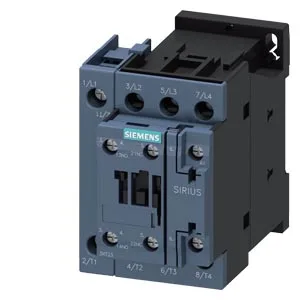
Siemens 3RT2327-2AK60 SIRIUS Contactor, Size S0, 60 mm
MPN3RT2327-2AK60
Active
Siemens SIRIUS 3RT2327-2AK60 contactor, size S0, AC coil, screw and snap-on mounting onto 35 mm DIN rail, 97 mm depth, 60 mm width, spring-type coil terminals.
Source DocumentedChannel stated on listing & quote
Condition PhotosReal unit photos / video on request
WhatsApp AnswersFast human replies for machine-down parts
Worldwide DispatchDHL/FedEx — transit quoted per order
Independent China distributor & sourcing agent· Listing updated Sep 2026
Specifications
| Parameter | Value |
|---|---|
| Contactor frame size | S0 |
| Parameter | Value |
|---|---|
| Rated operational current, AC-12, max. | 10 A |
| Rated operational current, AC-4 @ 400 V | 7.5 kW |
| Rated value @ 400 V | 3 A |
| Rated value @ 500 V | 2 A |
| Rated value @ 690 V | 1 A |
| Rated value @ 230 V | 10 A |
| Rated value @ 24 V | 10 A |
| Rated value @ 60 V | 6 A |
| Rated value @ 110 V | 1 A |
| Rated value @ 220 V | 0.3 A |
| Parameter | Value |
|---|---|
| Control supply voltage type | AC |
| Rated value @ 50 Hz | 0.25 |
| Rated value @ 50 Hz | 110 V |
| Parameter | Value |
|---|---|
| Main poles | 4 |
| Main NO contacts | 4 |
| Auxiliary contact reliability | 1 faulty switching per 100 million (17 V, 1 mA) |
| Parameter | Value |
|---|---|
| Short-circuit coordination type 1, fuse | gG: 63 A (690 V, 100 kA) |
| Short-circuit coordination type 2, fuse | gG: 20 A (690 V, 100 kA) |
| Aux. switch short-circuit protection, fuse | gG: 10 A (690 V, 1 kA) |
| Parameter | Value |
|---|---|
| Main circuit connection | spring-loaded terminals |
| Aux. / control circuit connection | spring-loaded terminals |
| Conductor cross-section, solid | 2x (0.5 ... 2.5 mm²) |
| Conductor cross-section, solid or stranded | 2x (0.5 ... 2.5 mm²) |
| Conductor cross-section, finely stranded w/ ferrule | 2x (0.5 ... 1.5 mm²) |
| Mounting method | screw and snap-on mounting onto 35 mm DIN rail according to DIN EN 60715 |
| Side-by-side mounting | Yes |
| Parameter | Value |
|---|---|
| Durability (operating cycles, typ.) | 10 000 000 |
| Durability with aux. switch block (cycles, typ.) | 10 000 000 |
| Parameter | Value |
|---|---|
| Operating temperature range | -25 ... +60 °C |
| Storage temperature range | -55 ... +80 °C |
| Installation altitude, max. | 2 000 m |
| Parameter | Value |
|---|---|
| Width | 60 mm |
| Height | 102 mm |
| Depth | 97 mm |
| Parameter | Value |
|---|---|
| At AC | 4 ... 16 ms |
Product details
Frequently asked questions
Where can I buy 3RT2327-2AK60 and get a price?
This part is sourced and quoted to order against an RFQ through independent distribution. Availability and current pricing are confirmed at quote time — submit an RFQ for a firm price and lead time.
Will 3RT2327-2AK60 drop into a panel specified for 3RT2015-2AP02 without rewiring?
Both are size S0 contactors with the same DIN-rail footprint, so mechanical fit is the same. The 3RT2327-2AK60 has an AC coil rated 110 V at 50 Hz / 120 V at 60 Hz, while the 3RT2015-2AP02 uses a different coil voltage — verify your control voltage matches before swapping. Wiring terminals are spring-type on both, so no lug change needed.
MPN
3RT2327-2AK60