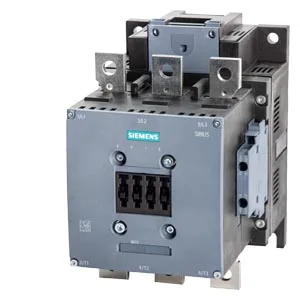
The Siemens 3RT5065-6AF36 is a SIRIUS S10 power contactor — screw-fixed, side-by-side mountable, with a built-in varistor across the coil. That varistor matters: it clips voltage spikes at coil dropout, which keeps the 24 VDC PLC output or the 110-127 V AC/DC control circuit from getting cooked by inductive kickback. No external snubber to wire. Rated insulation voltage is 1000 V, pollution degree 3, so it's built for industrial panels where conductive dust and humidity are present — not a clean-room part. Motor power ratings are 113 kW at 230 V and 197 kW at 400 V (both at 60 °C ambient). That's a big contactor — sized for a 200 kW-class motor on a pump, fan, or compressor in a 400 V distribution system. The AC-3e switching frequency maxes at 700 operations per hour; AC-4 (plugging/reversing) drops to 130 per hour. If your application jogs or reverses frequently, stay under that 130/h ceiling or the contacts won't last.
Sourcing and lifecycle — active, no LTB watch needed
RoHS compliance date is 03/01/2017, so it meets the EU RoHS directive for substances of concern. The evidence does not list UL or CSA marks explicitly, but the SIRIUS series typically carries them; confirm with your local Siemens representative if your panel requires a specific agency listing for the job site.
Panel fit and wiring — what the dimensions tell you
The S10 frame measures 145 mm wide × 210 mm high × 202 mm deep. That depth is the key number for enclosure selection: 202 mm means you need at least 250 mm clear depth on the gland plate to leave room for cables and bending radius. Screw fixing (not DIN-rail snap-on) means you drill and tap the backplate — plan the layout with that in mind. Side-by-side mounting is allowed (zero gap between contactors), which saves panel width when you stack multiple units. The mounting position is flexible: vertical surface, rotatable ±90°, tiltable ±22.5° front/back. That helps in tight retrofit cabinets where the backplate angle is non-ideal. Main circuit terminals accept up to 185 mm² cable (at both 40 °C and 60 °C). That's a serious lug — 185 mm² is roughly 4/0 AWG, typical for a 200 A feed. The auxiliary contacts are rated 6 A at 24 V, 1 A at 110 V, 0.3 A at 220 V, and 6 A at 230 V — enough for a PLC input or a status lamp, but not for pilot-duty solenoids without an interposing relay.
Switching frequency and duty — picking the right operating window
Maximum mechanical switching frequency is 2000 cycles per hour for both AC and DC operation. But the electrical limits are lower and duty-dependent: AC-1 (resistive loads) maxes at 800/h, AC-3 (squirrel-cage motors, normal start) at 700/h, AC-4 (plugging, inching, reversing) at just 130/h. The AC-3e rating (enhanced electrical endurance) also caps at 700/h. If your process cycles faster than these numbers, the contactor will overheat or wear prematurely — pick a larger frame or add a bypass contactor. It means the control transformer feeding this coil should be sized for the inrush, not just the sealed VA.