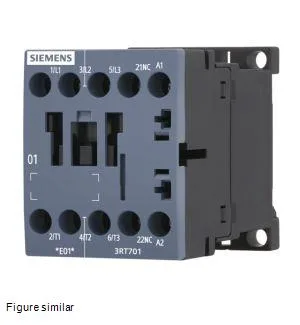
The 110 V AC coil draws 0.27 A at both 50 Hz and 60 Hz, with a closing power of 0.8 W DC and holding power of 0.27 W DC — low enough for direct PLC output drive in many cases, though the contact reliability spec (17 V, 5 mA) confirms it's rated for PLC-level auxiliary signals.
The AC-3 motor switching current is 6 A at 230 V, 3 A at 400 V, and 1 A at 690 V. These are the numbers that govern real motor starts — not a higher resistive rating. The insulation voltage is rated 690 V, and surge voltage resistance is 6 kV, which covers standard 400 V line-to-line panels with margin. Maximum switching rate is 750 operations per hour under AC-3 and 250 per hour under AC-4 (plugging/inching). The contactor accepts 2x (0.5 to 1.5 mm²) solid or stranded, or 2x (0.75 to 2.5 mm²) finely stranded with ferrules — screw-type terminals on both main and auxiliary circuits. Fuse coordination: type 2 (no damage) requires a 20 A gL/gG fuse; type 1 (allow damage) uses 35 A. This matters for selectivity studies — the 20 A limit is the one to design around if you want full coordination downstream.
The 45 mm width and 72 mm depth fit standard S00 footprint. Side-by-side mounting is permitted with no derating gap — useful for dense panels. Operating temperature is -10 to +55 °C; storage -25 to +70 °C. An auxiliary switch can be added via the product extension slot.