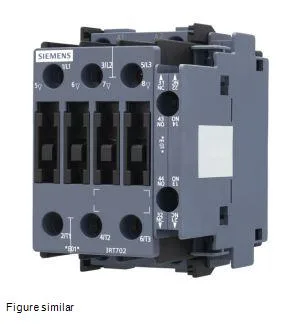
The Siemens 3RT7027-1AN20 is a S0 frame size contactor in the SIRIUS family, with three main poles and three normally-open main contacts. It mounts on a 35 mm DIN rail per DIN EN 50022 using the screw and snap-on method, and the mounting position allows ±180° rotation on a vertical surface plus ±22.5° tilt forward and backward. At 45 mm wide, it slots into a standard panel without special spacing.
The AC-3 rating at 690 V means this contactor handles the inrush and breaking of squirrel-cage motors up to that line voltage. Its auxiliary contact circuit is rated 6 A at 230 V, 3 A at 400 V, and 1 A at 690 V — so the same set of contacts can switch pilot duty loads across different control voltages.
Wiring and Coordination Notes
Both main and auxiliary/control circuits use screw-type terminals. The main circuit accepts solid or stranded wire: 2x (0.5 to 1.5 mm²) or 2x (0.75 to 2.5 mm²) per clamp, and the same range applies for finely stranded wire with ferrules. This is typical for a panel wireman working with standard control cable. For Type 2 coordination (no-weld after fault), the required upstream fuse is a gL/gG NH 3NA: 50 A. For Type 1 coordination (welding allowed but no fire risk), the same fuse type is rated 125 A. This matters when you're coordinating selectivity upstream in a distribution board. The magnet coil draws 0.72 W on closing and 0.24 W holding at DC — low enough that a standard 24 VDC PLC output or relay can drive it directly without an interposing relay in most cases.