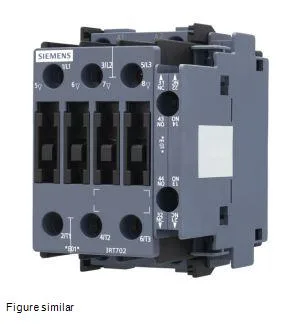
It carries three normally-open main contacts (3 NO) rated for AC-3 duty up to 690 V, with a 24 V AC coil that works on both 50 Hz and 60 Hz supplies. This is the standard screw-terminal variant — no auxiliary contacts built in, but the design accepts add-on auxiliary switch blocks when you need them.
The 690 V maximum operating voltage means it's fine on 400 V and 480 V systems, and the insulation voltage is also rated at 690 V (pollution degree 3), so it's suited for industrial environments where conductive dust or condensation is present. The coil holds at 24 V AC nominal, with a closing power draw of 0.72 W and a holding power of just 0.24 W — that's low enough to keep the control transformer small and the heat inside the panel manageable. Mechanical life is solid: the contactor is rated for 800 switching operations per hour at AC-3 maximum, and 250 per hour at AC-4 (plugging/inching duty). That's typical for a size S0 — it'll handle a conveyor start-stop cycle all day, but don't hammer it with reversing starts every few seconds without checking the thermal curve.
Installation notes from the field
They accept 2x (0.5 to 1.5 mm²) solid or stranded, or 2x (0.75 to 2.5 mm²) with ferrules. That's enough for standard motor leads up to about 2.5 mm² — if you're running larger cable, step up to the next frame size or use a terminal block in between. That helps when you're squeezing it into a crowded panel or aligning it with existing busbars. The operating temperature range is -10 to +55 °C, storage from -25 to +70 °C — fine for most indoor panel environments.