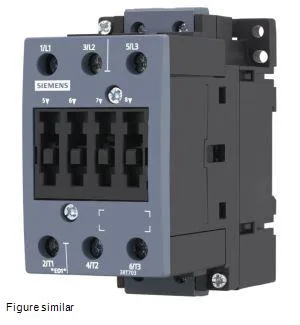
It carries three normally-open main contacts across three poles, rated for operational use up to 690 V AC-3 — the standard motor-switching duty class per IEC 60947-4-1. That 690 V ceiling means it handles 400 V and 480 V line supplies with headroom, and can be specified into 690 V delta-connected motor circuits common in European and mining installations. The control supply is AC only — 24 V at 50 Hz is the listed coil voltage — so this variant is not suited for DC-piloted control loops without an interposing relay. Coil inrush (closing) draws 0.79 W, holding at 0.36 W, which keeps the thermal load on a PLC output or pilot relay modest.
Mounting and installation fit
Side-by-side mounting is permitted with no derating gap, which saves rail space in dense panels. Dimensions are 55 mm wide, 112 mm high, 115 mm deep — the 55 mm width is the critical panel pitch dimension for multi-contactor assemblies. Terminals are screw-type for both main and auxiliary circuits, accepting 2x (0.5…1.5 mm²) solid/stranded or 2x (0.75…2.5 mm²) finely stranded with ferrules.
Environmental and protection class
Finger-safe IP20 on the front face; the terminal area is rated IP00, so the contactor must live inside an enclosure with a door or cover. Operating temperature range is -10 to +55 °C; storage from -25 to +70 °C. Surge voltage withstand is 6 kV, which aligns with basic insulation coordination for 400 V systems. Shock resistance is rated at 15g / 5 ms and 8g / 10 ms sine pulse — robust enough for most machine-mounted applications, but not for direct mounting on high-impact presses without vibration damping.
Switching performance and auxiliary capability
Rated for 800 switching cycles per hour at AC-3 (motor start/stop), and 250 cycles per hour at AC-4 (plugging/inching). The auxiliary contact block is field-addable — the product extension auxiliary switch is supported, so you can add NO/NC mirror contacts or early-make/late-break blocks without replacing the contactor. Auxiliary contacts are rated for PLC-level signals: the datasheet confirms reliability at 17 V, 5 mA — meaning they can switch low-energy DC inputs from a programmable controller without gold-plating or wetting current concerns. For DC-13 (solenoid/brake) loads at 220 V, the contactor is rated 0.3 A.
Short-circuit coordination and fuse sizing
This is critical for panel builders designing to IEC 60947-4-1 coordination tables — the 80 A fuse limit for type 2 means you cannot oversize the branch protection without risking contactor weld.
Cross-reference note: 3RT7036-1AG00
The closest functional sibling is the 3RT7036-1AG00, which shares the same S2 frame, same 3-pole/3-NO main contact arrangement, same 690 V AC-3 rating, and same 55 mm width. The difference is the control voltage: the -1AB00 is a 24 V AC coil; the -1AG00 is a 230 V AC coil. Mechanically and dimensionally they are identical — same DIN rail footprint, same terminal layout, same auxiliary add-on capability. If your panel is wired for 230 V control, the -1AG00 drops in without rewiring the power circuit; if you need 24 V AC control, the -1AB00 is the correct pick. No other functional delta exists between them for motor switching duty.