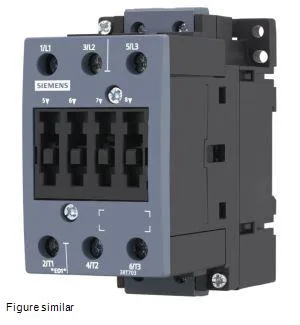
The 3RT7036-1AG20: Three main poles handle the load circuit; the contactor is rated for AC-3 duty up to 690 V, which covers most 400 V and 690 V motor applications in industrial panels. The auxiliary contact block supports a 230 V rated current of 6 A, 400 V at 3 A, and 690 V at 1 A — these are the switching limits for control or signaling circuits, not the main motor path.
Mechanical integration and mounting
Side-by-side mounting is permitted, so multiple contactors can pack tightly on the rail without mandatory spacing. Dimensions are 115 mm deep, 55 mm wide, 112 mm high — the S2 frame size keeps the footprint compact for a 3-pole contactor in this current class.
Coil and control supply
Coil draw is 0.36 A at 50 Hz and 0.38 A at 60 Hz. Closing power is 0.76 W DC; holding power drops to 0.35 W DC, which means the coil driver sees a brief inrush then a lower steady-state load.
Switching frequency and environmental limits
Maximum switching rate is 800 operations per hour under AC-3 duty and 250 per hour under AC-4 duty — AC-4 (plugging/inching) generates more arc wear, so the lower limit is the one to respect for frequent reversing or jogging applications.
Short-circuit coordination and wiring
These are the fuse sizes to specify when designing the branch circuit. Terminal wiring accepts 2x (0.5 to 1.5 mm²) or 2x (0.75 to 2.5 mm²) solid or stranded, and finely stranded with ferrules — covers standard panel wire sizes.