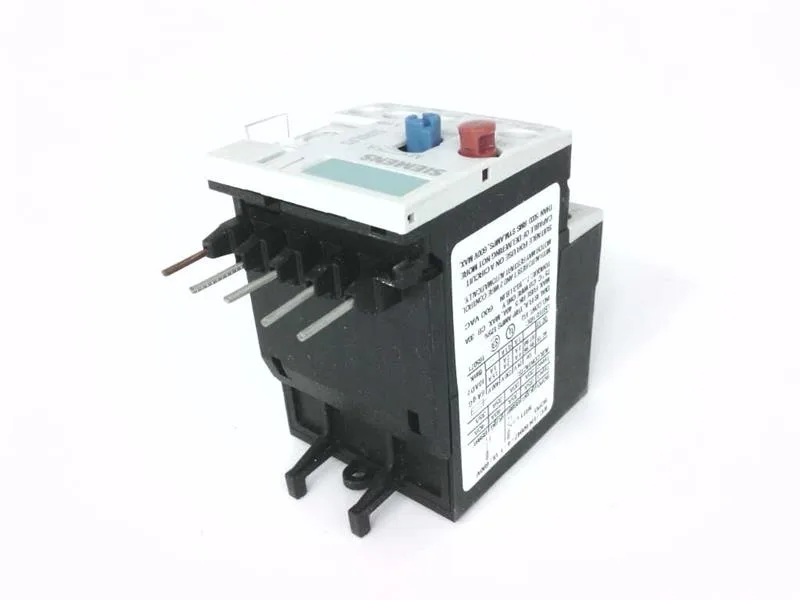
This one mounts directly to a contactor via the contactor mounting fastening method, saving a DIN-rail slot and keeping the power loop short.
Size S00 is the smallest SIRIUS frame — 45 mm wide, 87 mm tall, 78 mm deep. That depth (78 mm) is the dimension you need to clear behind the panel door or inside a shallow enclosure; it's the same depth as the matching S00 contactor, so the pair stacks flush. The IP20 front means finger-safe from the panel face, but the bottom terminals are live — standard for a control-panel component. Trip Class 10 means this relay is sized for motors that accelerate to full speed in under 10 seconds — most pumps, fans, and light conveyors. If you've got a high-inertia load (centrifuge, heavy crusher) that takes longer to start, you'd step up to a Class 20 or 30 relay. The 3RU1116-1JB0 is not that relay. The auxiliary contact ratings cover both AC and DC control circuits: 3 A at 120 V AC, 2 A at 230 V AC, 1 A at 400 V AC, and 1 A at 24 V DC. Power dissipation is 2.2 W per pole, so 6.6 W total through the main circuit at full load. That's modest — no forced cooling needed in a standard ventilated panel, but if you're packing a dozen of these in a sealed box, add it to the heat budget. The screw-type terminals accept solid wire from 2× (0.5…1.5 mm²) up to 2× (0.75…2.5 mm²) for both main and auxiliary circuits. AWG equivalents are 2× (20…16) and 2× (18…14). That covers most panel-building wire sizes; if you're terminating 12 AWG on the mains, the 2× 12 AWG entry confirms it's allowed.
This relay is designed to snap onto a Siemens SIRIUS S00 contactor (like the 3RT1016 or 3RT1023 series). The contactor mounting method means no DIN rail is consumed by the overload — it rides on the contactor's own footprint. The mounting position allows rotation of ±135° on a vertical surface and tilt of ±45° front-to-back, so you can orient the pair to fit tight gland plates or cable ducts. It carries ATEX certification (DMT 98 ATEX G 001), so it's approved for use in potentially explosive atmospheres when paired with a suitable contactor and installed per the system certificate. Shock resistance is 8g for 10 ms — fine for most industrial machinery, but not rated for continuous high-vibration environments like a crusher deck.