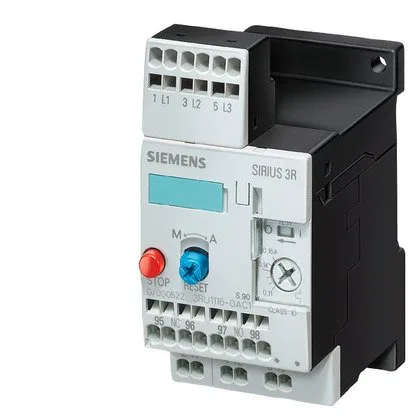
Mounting is via direct contactor mounting (fastening method), so it clips onto a matching SIRIUS contactor without additional DIN-rail hardware. The mounting position allows rotation of ±135° on a vertical surface and tilting of ±45° to front and back, giving panel layout flexibility.
Trip Class 10 is the standard for general-purpose motor starting — it coordinates with most IEC and NEMA motor designs. The 3-pole main circuit (Number Of Poles For Main Current Circuit: 3) covers three-phase motors directly. This is a qualification parameter for the insulation coordination, not a continuous rating — it confirms the relay can withstand switching transients common in motor circuits without flashover. Power dissipation per pole is 1.9 W, giving a total of 5.7 W for the three poles.
The 3RU1116-1CB0 carries ATEX approval (Type Of Protection: DMT 98 ATEX G 001), which qualifies it for use in potentially explosive gas atmospheres — typically Zone 2 or Zone 22 depending on the system certification. This is a documented certification, not a self-declaration, so it supports an audit trail for hazardous-area installations. Relative humidity during operation is rated at 100 %, which covers condensing environments — useful in washdown zones or outdoor cabinets provided the IP20 front is supplemented by the enclosure's own rating. Shock resistance is 8g for 10 ms, a standard industrial vibration specification that covers most motor-starter applications on fixed equipment. It is not rated for continuous high-frequency vibration (e.g., near a large reciprocating compressor) without additional damping.
Both the main circuit and auxiliary/control circuit use screw-type terminals. The main circuit accepts 2× (0.5…1.5 mm²) solid or 2× (0.75…2.5 mm²) solid/finely stranded with core-end processing. The auxiliary circuit accepts 2× (0.5…1.5 mm²) solid or 2× (0.75…2.5 mm²) — note the auxiliary terminals do not accept the larger 2.5 mm² strand count in the same gauge range as the main terminals. For AWG, main contacts accept 2× (20…16), 2× (18…14), and 2× 12; auxiliary contacts accept 2× (20…16) and 2× (18…14). This is a standard dual-terminal design for looping through without separate terminal blocks.
The relay measures 45 mm wide, 87 mm high, and 78 mm deep. Clearance requirements: 0 mm upwards, forwards, and backwards; 6 mm at the side; 0 mm downwards. The zero-clearance upward and forward dimensions are typical for contactor-mounted overloads — they sit flush against the contactor face. The 6 mm side clearance is the minimum gap to adjacent devices for heat dissipation and arc flash mitigation. Panel layout can be tight; the S00 frame is the smallest SIRIUS size.