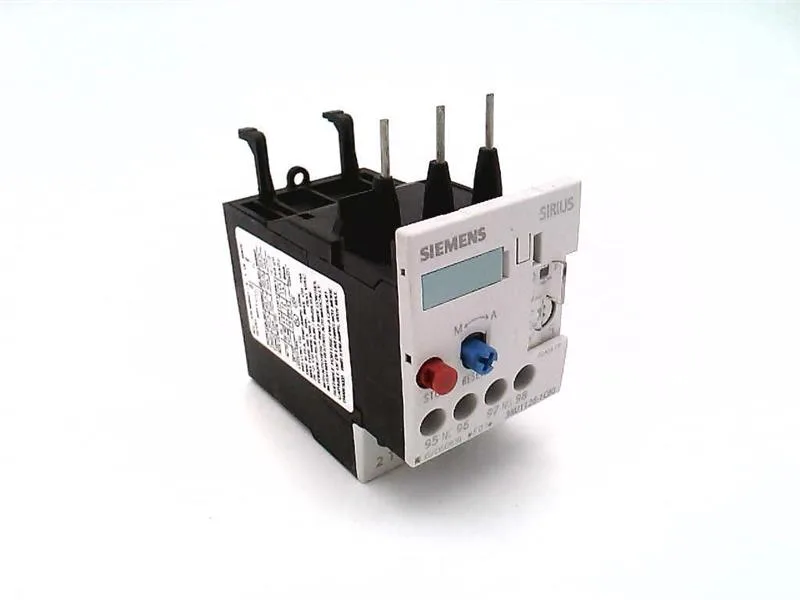
It mounts directly onto a contactor — no separate DIN-rail footprint needed — which keeps the panel layout tight and the wiring between the relay and contactor short. That's the standard for standard-duty motor starts — pumps, fans, compressors — where the start-up transient isn't prolonged. If you're dealing with high-inertia loads (centrifuges, flywheels), CLASS 10 may trip on start; you'd want to step up to CLASS 20 or CLASS 30. The auxiliary contacts are rated at 1 A at 24 V, 3 A at 120 V, and 2 A at 230 V — check your PLC input card's sink current against these numbers.
Mounts on the contactor via the fastening method — no extra hardware. The relay itself measures 97 mm high, 45 mm wide, and 96 mm deep. That means you can stack it tight against adjacent devices in a crowded panel. No derating needed for off-vertical orientation in most cases — but if you're tilting it into a tight corner, keep the ambient temperature derating curve in mind.
Front-of-unit protection is IP20 — finger-safe but not washdown. Relative humidity tolerance is 100 %, so condensation in non-climate-controlled enclosures won't cause nuisance tripping. Shock resistance is rated at 8 g for 10 ms — enough for most industrial environments but not for heavy hammering or crusher applications. The relay carries ATEX approval (DMT 98 ATEX G 001), so it's suitable for use in potentially explosive gas atmospheres when paired with an appropriate contactor.
Main circuit and auxiliary/control circuit both use screw-type terminals. Main contacts accept AWG 2x (16...12) or 2x (14...8) — solid or finely stranded with ferrule. The auxiliary circuit accepts 2x (0.5...1.5 mm²) or 2x (0.75...2.5 mm²) solid. No auxiliary contacts are included on this base unit — you add them separately if needed. Power dissipation at AC in hot operating state is 5.7 W total, or 1.9 W per pole. That's modest — no forced cooling required in a standard ventilated enclosure, but worth tallying if you're packing a dozen relays into a small box.