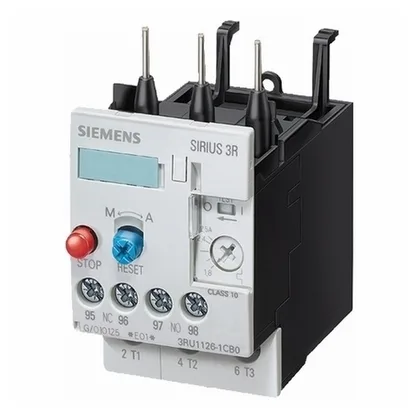
Trip Class 10 is the central selection parameter. It defines the maximum trip time at 7.2× the overload current setting — 10 seconds. For a motor with a 5-second starting time, Class 10 provides enough margin to start without tripping while still protecting the motor winding from sustained overload. If your motor has a longer acceleration time (e.g., high-inertia loads like centrifuges or crushers), you would need a Class 20 or Class 30 relay — this part is not suited for that duty. The shock resistance of 8g / 10 ms ensures the relay will not trip or fail under vibration from contactor operation or nearby machinery. If the panel ambient exceeds +70 °C, you must derate or relocate the relay — the thermal element is calibrated for that ambient. Relative humidity during operation can reach 100 %, which is typical for unheated enclosures in coastal or humid process areas, but the IP20 front means condensation inside the enclosure must be managed via drainage or a thermostatically controlled heater.
Mounting and wiring — what the dimensions tell you
The 3RU1126-4AB0 has a width of 45 mm, height of 97 mm, and depth of 96 mm. The Size S0 frame is the smallest in the SIRUS overload relay family, designed to pair with S0 contactors. The mounting method is contactor mounting — it snaps directly onto the contactor's base, saving DIN-rail space. The mounting position allows a vertical mounting surface with +/-135° rotation and +/-45° tilt to the front and back, giving panel builders flexibility in tight enclosures. Clearance requirements: 0 mm upwards, forwards, backwards, and downwards, but 6 mm at the side. This means you can stack relays vertically with no gap, but you need 6 mm of side clearance for heat dissipation and wiring access. The screw-type terminals for both main and auxiliary circuits accept solid conductors: 2x (0.5... 1.5 mm²) and 2x (0.75... 2.5 mm²), or AWG equivalents 2x (16... 12) and 2x (14... 8) for main contacts, and 2x (20... 16) and 2x (18... 14) for auxiliary contacts. Finely stranded wire with core end processing uses the same cross-sections.
Lifecycle and sourcing reality — current production, ATEX compliance
The ATEX certification DMT 98 ATEX G 001 is a key differentiator for process industry buyers. It certifies the relay for use in gas atmospheres (Group II, Category 2G or 3G depending on installation). If your site requires ATEX documentation for the motor protection circuit, this part carries it — a bare thermal overload relay without ATEX marking would not satisfy the equipment dossier for a hazardous area.
The closest functional peer in the evidence is the 3RU2116-1FC1. Both are SIRIUS thermal overload relays in Size S0, Trip Class 10, with screw terminals and contactor mounting.