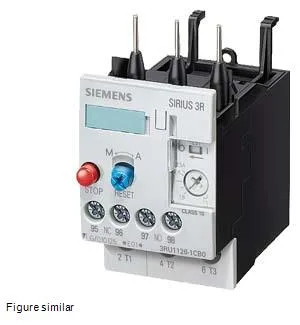
Trip Class 10 governs the thermal memory: at a cold start, a locked-rotor condition clears within 10 seconds, matching the heating curve of a standard squirrel-cage motor. Surge voltage resistance is 6 kV, which covers the impulse withstand for 400 V industrial panels per IEC 60947. The auxiliary contact ratings give the control-circuit designer clear numbers: 1 A at 24 V, 0.22 A at 110 V, 0.22 A at 125 V, 0.11 A at 220 V, and 3 A at 120 V, 2 A at 230 V, 1 A at 400 V. These are the switching capacities for the N/C and N/O contacts feeding the PLC input or contactor coil — the 120 V / 230 V figures are the ones to size against for a typical North American or European control voltage. The relay carries ATEX approval DMT 98 ATEX G 001, so it can be installed in Zone 2 gas hazardous areas when paired with an appropriate contactor.
The relay is designed for stand-alone installation or direct mounting to a SIRIUS contactor. The mounting position allows vertical surface installation with +/-135° rotation and +/-45° tilt front-to-back, so it fits tight enclosures without special brackets. Clearances: 0 mm upwards, forwards, backwards, and downwards — zero gap to adjacent devices. Side clearance is 6 mm. That means it stacks tight on the DIN rail with no wasted panel space. Main circuit terminals accept 1x (16…12) AWG solid or 1x (14…8) AWG stranded. Auxiliary and control circuit terminals accept 2x (20…16) AWG or 2x (18…14) AWG. For finely stranded wire with ferrule, the range is 2x (0.5…1.5 mm²) and 2x (0.75…2.5 mm²). The kit is complete — no extra terminal adapters or jumper packs needed for standard builds.