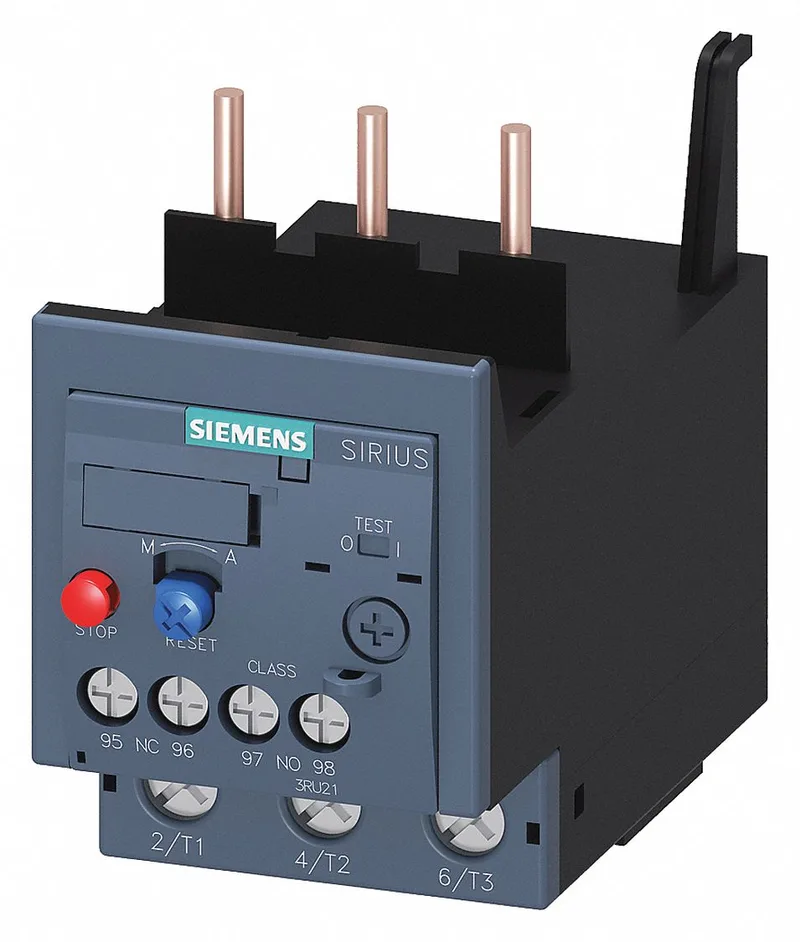
CLASS 10 Trip — What It Means for Motor Starting
The 3RU2136-4EB0 is a CLASS 10 thermal overload relay. That means at 7.2× the full-load current setting, the bimetal trip must open within 10 seconds. For a standard motor driving a pump, fan, or conveyor, CLASS 10 gives enough time for the starting inrush to pass without nuisance tripping, but it's not meant for high-inertia loads like flywheels or crushers — those need CLASS 20 or CLASS 30. If your motor starts against a heavy load and the relay trips during start, the CLASS 10 ceiling is the first thing to check.
S2 Frame — Mounting and Panel Fit
This is an S2-size overload relay from the SIRIUS family. It mounts directly onto the matching SIRIUS contactor via the fastening method listed as 'contactor mounting' — there is no DIN-rail clip on the relay itself. The main contacts use M6 screws. The dimensions are 55 mm wide, 90 mm high, 105 mm deep. That depth includes the contactor body underneath; plan for at least 120 mm of enclosure depth to clear the wiring and the manual reset button.
Auxiliary Contact Ratings — Control Circuit Limits
The integrated auxiliary switch is rated for control-circuit voltages across the board: 2 A at 24 V, 3 A at 120 V, 2 A at 230 V, 1 A at 400 V, and 0.75 A at 690 V. At 60 V it drops to 0.3 A; at 110 V and 125 V it's 0.22 A; at 220 V it's 0.11 A. These are the switching limits for the signal contacts — if your PLC output card sources more than 3 A at 120 V, you need an interposing relay. The per-pole power dissipation is 4.6 W, which matters for thermal budgeting inside a sealed enclosure.
Motor Power Ratings — Which Voltage Matches Your Motor
The relay's motor power ratings are voltage-dependent: 15 kW at 400 V, 18.5 kW at 500 V, and 30 kW at 690 V. At 480 V and 600 V the rating is 32 A — that's the current limit, not a power figure. For a 480 V motor, 32 A corresponds to roughly 22 kW (30 HP) in a standard NEMA design. The maximum rated voltage is 690 V, and the AC-3e rated voltage maximum is also 690 V. The trip class is thermal, so ambient temperature compensation is active from -40 to +60 °C.