CLASS 10A trip curve and motor protection fit
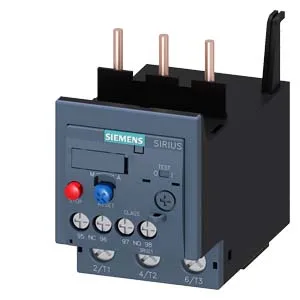
The 3RU2136-4RB0 is a SIRIUS thermal overload relay with a CLASS 10A trip class, meaning it will trip within 10 seconds at 7.2× the current setting — fast enough to protect standard induction motors during a locked-rotor event without nuisance tripping on normal starting transients. Rated for AC-3e duty up to 690 V, it handles motor loads at 37 kW at 400 V, 55 kW at 500 V, and 75 kW at 690 V, with a maximum continuous current of 80 A at both 480 V and 600 V. The thermal bimetallic release design compensates for ambient temperature changes across -40 to +60 °C, so the trip point stays accurate whether the panel sits in a cold warehouse or a warm machine room.
Mounting and wiring — contactor-mount S2 frame
Fastens directly to the contactor via the M6 main contact screws — no DIN-rail adapter needed, which saves rail space in a crowded panel. Main circuit terminals accept 2x (0.5 to 1.5 mm²) or 2x (0.75 to 2.5 mm²) solid or stranded wire, terminated with screw-type terminals requiring a Pozidriv PZ 2 screwdriver tip. Dimensions are 55 mm wide, 90 mm high, and 105 mm deep — the S2 frame size fits the standard SIRIUS contactor footprint.
Auxiliary contact ratings and power dissipation
The integrated auxiliary switch (NO/NC changeover) is rated 2 A at 24 V, 3 A at 120 V, 2 A at 230 V, 1 A at 400 V, and 0.75 A at 690 V — these are the make/break capacities for the signal circuit, not the main motor current. At lower control voltages, the 60 V rating drops to 0.3 A, and at 125 V or 220 V it is 0.22 A and 0.11 A respectively — important when selecting a PLC output or control transformer for the trip signal. Each pole dissipates 6.3 W at rated current — factor this into the panel thermal budget, especially in a sealed enclosure with multiple relays stacked.
Environmental range and compliance
Operates from -40 to +70 °C and survives storage and transport from -55 to +80 °C — suitable for unheated warehouses and truck shipments across climate zones. Mountable in any position, which simplifies panel layout when the contactor is oriented vertically or horizontally. Substance prohibitance dated October 15, 2014, indicating RoHS compliance per the EU directive effective from that date.