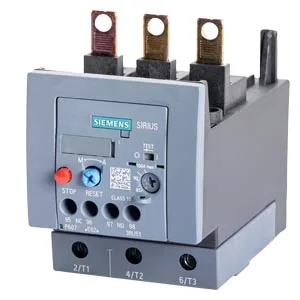
It mounts directly onto a SIRIUS S3 contactor (no separate base required), saving DIN-rail space and wiring time. The adjustable current response range is 22 to 32 A, with a rated operational current of 32 A.
The 22-32 A adjustable range covers motor FLA from 22 A to 32 A. The 3-pole design matches a three-phase motor. That heat has to go somewhere — the relay relies on natural convection, so the required 6 mm spacing to grounded parts at the side isn't optional. Stacking relays tighter than that derates the trip curve. Humidity tolerance is 0 to 100%, so condensation inside a non-condensing enclosure is fine, but direct washdown isn't — the screw terminals are IP20 at best without an enclosure. Mounting position: vertical surface with ±135° rotation or ±45° tilt front/back.
The 3RU5146-4EB0 is the screw-terminal variant. If your panel uses spring-cage or ring-lug terminations, there's a sibling with the same current range and different terminal style — same trip curve, same S3 footprint. No rewiring of the panel layout needed, just the lug type.
Dimensions: 70 mm wide, 120 mm tall, 140 mm deep. It clips onto the contactor — no DIN-rail footprint of its own. That means the contactor's width (typically 45 or 55 mm for S3) determines the combined width; the relay adds depth behind it. Wire sizes: main circuit accepts 2×(0.5-1.5 mm²) or 2×(0.75-2.5 mm²) solid/stranded, or AWG 2×(10-1/0). Auxiliary/control circuit: 2×(20-16) or 2×(18-14) AWG. Tightening torque for main terminals: 4-6 N·m. Use a torque screwdriver — under-torquing creates a hot joint that fools the bimetallic strip into early tripping. Short-circuit protection for the auxiliary switch: fuse gL/gG 6 A or quick-acting 10 A. That's for the control circuit, not the main power — the main circuit protection is sized to the upstream breaker or fuse feeding the contactor.
Rated insulation voltage: 1000 V AC at pollution degree 3. Rated operating voltage: 1000 V. Surge voltage resistance: 8 kV. Shock resistance: 8 g for 10 ms per IEC 60068-2-27. Frequency: 50-60 Hz. Substance prohibitance date: July 1, 2006 — aligns with RoHS compliance.