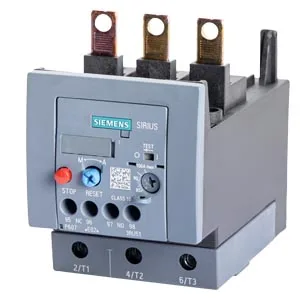
Adjustable from 36 to 50 A, it sits on top of an S3-size contactor and shares the same DIN-rail footprint.
Rated operational current is 50 A at up to 1000 V on a 50/60 Hz line. That 50 A is the thermal continuous rating — the relay can carry that current indefinitely without tripping. The adjustable range (36-50 A) lets you dial in the motor FLA without swapping the relay. Power loss at rated current in hot operation is 15.3 W, total typical 16.5 W — that heat has to escape, so the 6 mm side spacing to grounded parts is not optional; stack them tighter and the ambient inside the enclosure rises, shifting the trip curve. Surge voltage resistance is 8 kV — that's the impulse withstand for the auxiliary contacts, not the main circuit. The main circuit insulation voltage is 1000 V at pollution degree 3, which covers most industrial panels up to 690 V line-to-line. Shock resistance per IEC 60068-2-27 is 8g for 10 ms — fine for a contactor-mounted relay on a panel door, but not for direct machine-mount without damping.
Fastening method is contactor mounting — it clips directly onto the S3 contactor, no DIN rail needed for the relay itself. Main circuit terminals are screw-type, top and bottom, accepting 2×(0.5…1.5 mm²) solid/stranded or 2×(0.75…2.5 mm²), or AWG 2×(10…1/0) and 1×(10…2/0). Torque spec is 4-6 N·m — don't guess it; under-torque gives a hot joint that fools the bimetallic strip. Auxiliary and control circuits also use screw terminals, accepting 2×(20…16) or 2×(18…14) AWG.
Relative humidity during operation can go 0 to 100 % — no condensation limit stated, but with the bimetallic design, condensation on the terminals is the real concern, not the strip. Installation altitude max is 2000 m; above that, derate the current or the dielectric strength drops. Substance prohibition date per RoHS-like compliance is 07/01/2006 — the part is RoHS-compliant as of that date.