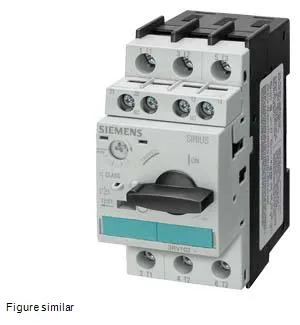
The Siemens 3RV1021-4CA15 is a SIRIUS motor-protective circuit breaker — the device that sits between the contactor and the motor in a standard motor feeder. Rated continuous current is 22 A, which at 400 V AC-3 translates to 11 kW motor output — typical for a small conveyor, pump, or fan drive.
Short-circuit breaking capacity is rated per voltage: 100 kA at 240 V AC, 50 kA at 400 V AC, 10 kA at 500 V AC, and 4 kA at 690 V AC. At 400 V, the 50 kA figure gives plenty of headroom for most industrial distribution panels — you can usually achieve full selectivity with an upstream fuse or molded-case breaker without special coordination studies.
The 45 x 97 x 96 mm (W x H x D) footprint fits standard DIN-rail enclosures. Zero clearance required at the back and sides — the device can be butted directly against adjacent breakers or the panel wall, which saves rail space in dense layouts. IP20 on the front face means basic finger protection; no cover is needed for the operator side, but the terminals are live when energized.
Main and auxiliary circuits use screw-type terminals. The main circuit accepts solid conductors 2x (0.5…1.5 mm²) or 2x (0.75…2.5 mm²), and stranded conductors 2x (1…2.5 mm²) or 2x (2.5…6 mm²). Auxiliary/control circuit terminals take 2x (0.5…1.5 mm²) solid or 2x (1…2.5 mm²) stranded — enough for the control wiring from a PLC or relay.
Auxiliary contacts and diagnostics
An auxiliary switch is built in (transverse design), but the base unit ships with zero auxiliary contacts fitted — you add the contact block separately if you need a remote trip signal. Phase failure detection is standard: the breaker will trip if one phase drops out, which is essential for preventing single-phasing damage on three-phase motors. No ground-fault detection on this variant.