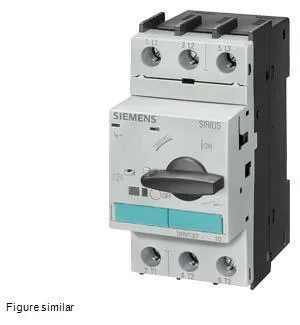
Rated continuous current sits at 0.32 A, with a symmetrical breaking capacity of 100 kA at 400 V AC, 500 V AC, and 690 V AC. That 100 kA rating holds across the voltage band, so it handles high-fault-current scenarios without derating the interrupt rating at higher voltages — a useful trait when the panel feeds a transformer or a long bus run.
RoHS compliance date is 01.05.2012, so it meets the EU RoHS directive. The part carries no ground fault or phase failure detection — it's a straight thermal-magnetic overload and short-circuit protector for the motor branch. If your BOM requires those detection functions, you'd need a separate monitoring relay or a different SIRIUS variant.
Solid and stranded conductors: 2x (1... 2.5 mm²) or 2x (2.5... 6 mm²) per terminal. AWG equivalents: 2x (14... 10). That's enough for the 0.32 A load — 1.5 mm² is plenty, but the terminal also accepts up to 6 mm² for daisy-chaining or feed-through. Finely stranded with core-end processing uses the same range. Power dissipation at AC in hot operating state is 5.5 W total, 1.8 W per pole. That's low enough that no special ventilation is needed in a standard IP20 enclosure, but if you're stacking multiple units side-by-side with zero spacing, the cumulative heat adds up — the 0 mm side clearance spec means you can butt them, but watch the ambient inside the panel.