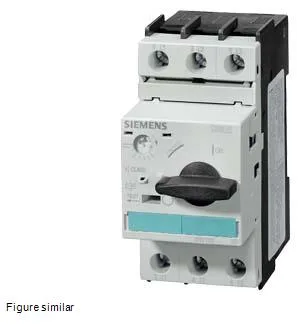
The Siemens 3RV1421-1JA38-1KT0 is a SIRIUS-branded circuit breaker specifically designed for transformer protection. This is a compact unit at 45 mm wide, 97 mm tall, and 96 mm deep — it fits neatly on a 35 mm DIN rail per EN 50022, using either screws or the snap-on mechanism.
At 240 V and 400 V AC it's rated for 100 kA — that's a very high fault-current capability, typical for a motor-protective device that sits close to a transformer or a high-capacity bus. At 500 V AC that drops to 42 kA, and at 690 V AC it's 6 kA.
Duty cycle and thermal performance
Rated for AC-3 switching duty at up to 690 V, the breaker is good for 15 operations per hour maximum. That's fine for transformer primary protection or infrequent motor switching, but not for a high-cycling application like a rapid-start conveyor. The main contacts are rated for 100,000 mechanical operations typical, and the power dissipation in a hot state runs 9.25 W — something to account for in a crowded enclosure.
Environmental and mounting conditions
The screw terminals for the main circuit accept 2x 0.25 to 2.5 mm² solid or stranded, or 2x 24 to 14 AWG. Auxiliary switch is present and transverse design, but there are zero auxiliary contacts on the main switch itself.