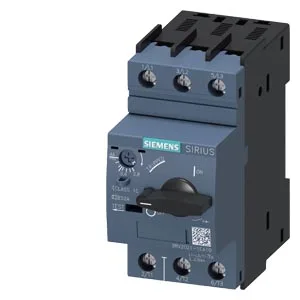
What it is and what it does
The Siemens 3RV2021-1EA10 is a SIRIUS motor protection circuit breaker — the device that sits between your contactor and the motor, watching for overload and short-circuit conditions. It's designed to protect motor loads, not general distribution circuits, so it carries phase-failure detection and a Class 10 trip curve, meaning it will clear a stalled-rotor condition fast enough to keep the windings from cooking. Out here in the grease, that's the difference between swapping a breaker and rewinding a motor. The interrupting rating tells you where this breaker can live in the fault-current hierarchy: 100 kA at 240 V, 400 V, and 500 V. That's a high SCCR — it can sit downstream of a transformer or a busway without needing a current-limiting fuse ahead of it, as long as the available fault current stays under that number. At 690 V the rating drops to 4 kA, so if you're running a 690 V line, you need to check coordination with the upstream device.
Mounting and panel fit
Mounts via screw and snap-on onto 35 mm DIN rail per DIN EN 60715. The 45 mm width and 97 mm depth are standard for the SIRIUS 3RV2 frame — it occupies one 45 mm slot on the rail, same as the contactor it pairs with. Clearance requirements: 50 mm above and below, 30 mm to the side, zero forward or backward. That matters when you're shoehorning this into an existing panel — you need breathing room for the arc chute to do its job. Terminals are screw-type for the main current circuit, accepting 2x 1–2.5 mm² or 2x 2.5–10 mm² solid or stranded. Main contact screws are M4. Mounting position is any — no derating needed if you lay it sideways or upside down, which helps in tight cabinets.
Lifecycle and sourcing reality
For a buyer filling a BOM line: this part is sourced and quoted to order against an RFQ. Availability and current pricing are confirmed at quote time. If you're cross-referencing from a different manufacturer's motor-protection breaker, the key fit parameters are the 45 mm width, the Class 10 trip characteristic, and the 100 kA SCCR at your system voltage — those are the numbers that decide whether it drops in without a panel re-spin.
What the ratings mean for your motor circuit
The Class 10 trip class means the breaker will trip within 10 seconds at 7.2× the thermal setting — that's the standard for standard-duty induction motors. If you're protecting a submersible pump or a conveyor motor that starts under load, Class 10 is the right call; Class 20 would let the motor sit at locked-rotor current longer, and that's how you cook the insulation. Phase-failure detection is built in — if one leg drops out, the breaker trips. That's important on a three-phase motor because single-phasing will draw high current in the remaining phases and burn the winding fast. Some economy breakers skip this; the 3RV2021-1EA10 does not. Rated operating voltage spans 20 to 690 V — covers everything from 24 V control transformers up to 690 V industrial mains. The operating temperature range is -20 to +60 °C, storage and transport from -50 to +80 °C. That -20 °C floor matters if the panel sits in an unheated warehouse in a cold climate; the breaker will still trip within spec when the building heat is off.
