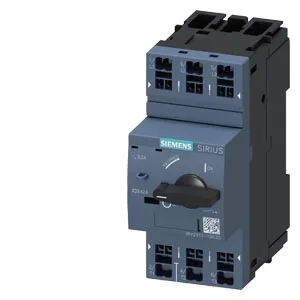
Rated 3.2 A at both 480 V and 600 V, it covers small motor loads up to 2 hp at 460/480 V or 575/600 V, and 0.75 hp at 220/230 V — the horsepower ratings align with standard NEMA motor frames. The breaking capacity is the headline number here: 100 kA at 240 V, 400 V, and 500 V, dropping to 10 kA at 690 V.
The 45 mm width (3 module spaces) and 97 mm depth fit standard panel layouts; clearance requirements are 50 mm upwards and downwards, 30 mm to the side, zero forwards or backwards.
For most industrial panels fed from a 400 V transformer, that's enough headroom to avoid series-rating complications. The switching frequency is capped at 15 operations per hour under AC-3 duty (motor starting). That is typical for a motor-protective device — not meant for frequent jogging or rapid cycling, but fine for normal start/stop cycles on a conveyor or pump. No ground-fault or phase-failure detection built in — this is a straight thermal-magnetic breaker for overload and short-circuit protection. If those functions are needed, they must be added externally or via a separate monitoring relay.