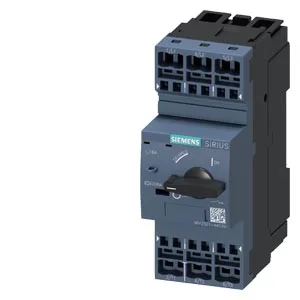
Rated voltage range is 20 to 690 V, covering most common industrial supply levels from control transformers up to 690 V line.
At 240 V AC the rating rises to 100 kA, and at 690 V AC it drops to 2 kA — the voltage derating curve is steep, so if your line runs at 690 V, verify the available fault current stays under 2 kA or add a current-limiting upstream fuse. The breaker also carries fuse backup ratings: gL/gG 63 A at 400 V, 50 A at 500 V, and 40 A at 690 V — these are the maximum upstream fuse ratings that preserve the breaker's interrupting capability in a coordinated pair.
Motor ratings and operating cycle
Motor full-load current equivalents: 10 hp at 460/480 V, 5 hp at 220/230 V, 3 hp at 200/208 V, 2 hp at 230 V, and 1 hp at 110/120 V — these are the NEMA horsepower ratings the breaker protects in typical North American motor circuits. Maximum switching rate under AC-3 (motor starting) duty is 15 operations per hour — adequate for a pump or fan that cycles a few times an hour, but not for a high-speed indexing application.
Clearance requirements: 50 mm upwards and downwards, 30 mm to the side, 0 mm forwards and backwards — the zero forward/backward clearance means it can sit flush against the back panel or a busbar shield, but the 50 mm vertical gap is mandatory for arc-chamber venting and terminal access.