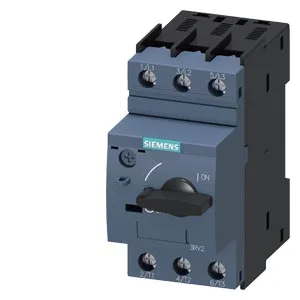
Transformer-protection breaker with 25 kA interrupting capacity
That distinction matters: the trip curve and short-circuit ratings are tuned for inrush-heavy transformer loads rather than motor starting profiles.
The 25 kA at 400 V is the SCCR (short-circuit current rating) that governs whether this breaker coordinates with upstream protective devices in a panel. If your transformer secondary fault current exceeds 25 kA at 400 V, this breaker won't safely interrupt — you'd need a higher-rated device or current-limiting fuses ahead of it. At 240 V the rating jumps to 100 kA, so on 240 V secondaries it's very robust. The gL/gG fuse coordination values (63 A at 400 V, 50 A at 500 V and 690 V) tell you the maximum upstream fuse that still allows the breaker to clear a fault without the fuse blowing first — critical for selective coordination studies.
The 45 mm width means it takes one standard 45 mm module slot — no surprise when panel-building. Terminal screws are M4 for the main contacts, accepting 2x (1 to 2.5 mm²) or 2x (2.5 to 10 mm²) solid or stranded copper. Clearance requirements: 50 mm upwards and downwards, 30 mm at the sides, 0 mm forwards and backwards — tight on the backplane, but leave breathing room above and below for arc quenching.