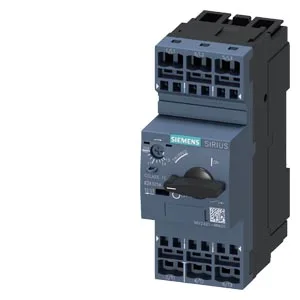
The Siemens 3RV2421-4BA20 is a SIRIUS circuit breaker for transformer protection. At 690 V it still interrupts 2 kA (cite:), enough for most 690 V line-side faults in European-style panels. No ground fault detection on this variant (cite:), so if that's required, you'd step up to the GF version in the same frame.
Width is 45 mm, depth 97 mm, height 119 mm. Mounting position is any orientation. Clearance requirements: 50 mm upwards and downwards, 30 mm to the side (cite:,). Zero clearance forwards and backwards (cite:,) — so you can butt it against the back panel or a busbar cover without derating. That's tighter than many breakers in this class; useful when you're packing multiple units into a shallow enclosure. No screw-clamp torque to verify, which speeds up panel wiring. The spring terminals are the same across the 3RV2 family, so if your panel shop is already tooled for this series, no change in termination practice.
Fuse coordination and operating limits
The breaker is coordinated with gL/gG fuses at specific voltages: 63 A at 400 V (cite:), 50 A at both 500 V and 690 V (cite:,). This means the upstream fuse must be at or below these ratings to ensure the breaker clears a fault without the fuse blowing first — standard selectivity practice for transformer protection. Maximum switching frequency in AC-3 duty is 15 operations per hour (cite:,) — this is not a breaker for frequent motor starting. It's designed for infrequent transformer switching (energization and fault clearing), not cyclic loads. Rated insulation voltage is 20 to 690 V (cite:), covering standard low-voltage networks worldwide. Horsepower ratings are provided for common voltages: 3 hp at 230 V (cite:), 5 hp at 220/230 V (cite:), 7.5 hp at 200/208 V (cite:), 10 hp at 460/480 V (cite:). These are the transformer kVA equivalents, not motor FLA — use them for transformer sizing, not motor selection.
Lifecycle status is current (cite:) — this is an active, in-production part from Siemens. The SIRIUS 3RV2 series is the current generation of compact circuit breakers; there is no successor to watch for because this is the current design.