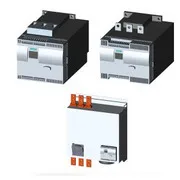
Rated current and thermal derating — what the 161 A figure actually means for your motor
The 3RW4427-1BC35: At 50 °C the rating drops to 142 A, and at 60 °C it falls to 125 A, so the panel ambient temperature directly governs the motor FLA you can connect. Derating begins at 40 °C; above that, the output must be reduced per the natural convection curve of the SIRIUS enclosure.
Integrated bypass and inside-delta wiring — why this matters for heat and panel space
An integrated bypass contact system is built in, so once the motor reaches full speed the thyristors are shorted and all heat generation stops — no external bypass contactor needed. Inside-delta circuit wiring is supported, which lets the soft starter handle a motor with the windings connected in delta while the starter sees phase current rather than line current — effectively doubling the current capability for the same unit.
Mounting, clearances, and pollution degree — fitting it into the enclosure
Mounting is by screw fixing; the unit can be rotated ±90° on a vertical surface or tilted ±22.5° front-to-back, giving flexibility in tight cabinets. Required clearances: 100 mm above, 75 mm below, and 5 mm at the sides — the vertical gap is critical for the thyristor heat sink convection path. Dimensions: 192 mm high, 170 mm wide, 270 mm deep — confirm the backpanel depth before laying out the gland plate.
Protection, control, and minimum load — what the soft starter handles on its own
Motor overload protection is built in, along with intrinsic device protection (thyristor overtemperature, phase imbalance, etc.) — no separate overload relay is required for most applications. Adjustable current limitation lets you set the starting current between the motor's no-load current and the unit's rated current, which is useful for limiting supply dips on weak grids. Minimum load is 8 % of the rated current — below that the soft starter may not detect the motor load correctly, so verify the motor no-load current exceeds this threshold. Maximum motor cable length is 500 m — beyond that, capacitive charging currents can cause nuisance tripping or thyristor misfiring. External reset input is available, and a display shows fault signals for on-device diagnostics.