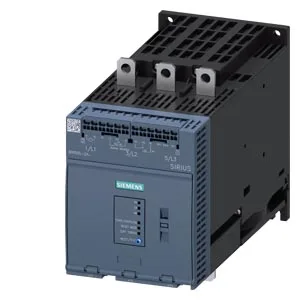
What the 68 A minimum and trip class mean for your motor start
The 3RW5055-2AB05 is a hybrid switching device — a soft starter — with a minimum settable current of 68 A, meaning it is sized for motor FLCs at or above that floor; below 68 A the overload protection cannot be calibrated down far enough to protect the motor. Trip class is selectable as CLASS 10A, 10E (preset), or 20E per IEC 60947-4-2 — this controls the maximum allowable start time before the overload trips. Class 10A suits high-inertia loads like centrifuges; Class 20E gives extra headroom for long acceleration ramps on conveyors or crushers. Rated operating voltage is 200 to 600 V, covering common global low-voltage motor supplies from 208 V to 600 V without a tap change.
ATEX, UKEX, IECEx — what the approvals cover
This soft starter carries ATEX, UKEX, and IECEx certification — meaning it is approved for use in potentially explosive atmospheres as part of a motor-starting assembly, provided the rest of the installation (cable glands, enclosure, motor) also meets the zone requirements. UL and CSA approval, plus CE marking, round out the compliance set for North American and European installations — the part ships with the documentation needed for a panel builder's declaration of conformity.
Fieldbus integration — PROFIBUS, Modbus, EtherNet/IP, PROFINET
The 3RW5055-2AB05 supports PROFIBUS, Modbus RTU, Modbus TCP, EtherNet/IP, and PROFINET standard — the communication module is integrated, so no separate gateway is needed for most PLC networks. PROFIenergy is available in conjunction with the PROFINET standard communication module — this allows the soft starter to participate in energy-management profiles during production pauses.
Mounting and environmental limits for panel integration
Fastening is by screw fixing — not DIN-rail snap-on — so plan for four mounting points on the panel backplate. Dimensions are 120 mm wide, 198 mm high, 249 mm deep. Mounting position allows a vertical mounting surface with +/-90° rotation and +/-22.5° tilt forward/back — useful when the panel layout forces an off-axis orientation. Shock resistance is 15 g / 11 ms, with potential contact lifting starting at 12 g / 11 ms — relevant for installations on vibrating machinery or in mobile equipment.