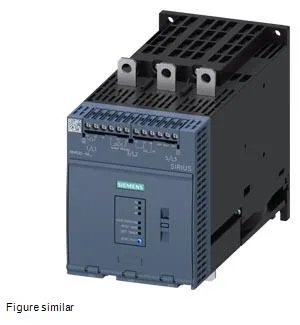
Soft starter with voltage ramp, not torque control
The 3RW5055-6AB04 is a voltage-ramp soft starter — it does not offer torque control. That means starting profiles are shaped by ramping the motor voltage up over time, not by regulating current or torque directly. For applications where pump ramp down or soft torque is needed, the voltage ramp method works well; for constant-torque loads like conveyors, a current-limit starter would be a better fit. Rated minimum current is 68 A at 200-480 V, covering standard low-voltage three-phase supplies across most industrial regions. The trip class is selectable between CLASS 10A, 10E (preset), and 20E per IEC 60947-4-2 — this sets the thermal overload protection profile for the motor. Class 10A trips faster under locked-rotor conditions, suitable for submersible pumps; class 20E allows longer start times for high-inertia loads.
Fieldbus and hazardous-area approvals
This soft starter carries ATEX, UKEX, and IECEx certification — it is listed for use in explosive atmospheres, which is uncommon for this product class. The approvals cover the device itself, not just the enclosure; check the specific gas/dust group and temperature class on the nameplate before installing in a Zone 1 or Zone 2 area. On the communications side, it supports PROFIBUS, Modbus RTU, Modbus TCP, EtherNet/IP, and PROFINET — essentially every common industrial Ethernet and fieldbus protocol. The PROFINET interface also supports PROFIenergy for energy management during idle periods. The analog output is configurable as 4-20 mA or 0-10 V, which can feed a remote SCADA or PLC input for motor current trending. UL and CSA approvals are present, so the unit is accepted in North American installations without additional agency review. CE marking covers European compliance.
Mounting and environmental limits
Mounting is by screw fixing — not DIN-rail snap-on. The dimensions are 120 mm wide, 249 mm deep, 198 mm high. Clearance requirements: 100 mm upwards, 10 mm forwards, 0 mm backwards, 75 mm downwards, and 5 mm at the sides. These are minimums for airflow and arc flash; in a sealed enclosure, increase the top clearance for natural convection. The mounting position allows vertical surface mounting with +/-90° rotation and +/-22.5° tilt front-to-back. Shock resistance is 15 g for 11 ms, dropping to 12 g / 11 ms if potential contact lifting is a concern.