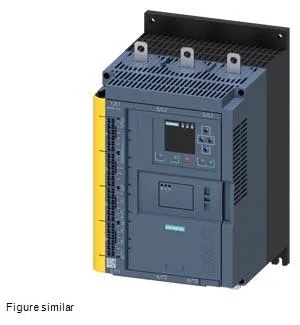
ATEX-rated soft starter for hazardous-area motor control
The Siemens 3RW5534-2HF04 is a soft starter with ATEX and IECEx certification, meaning it can be installed in Zone 1 or Zone 2 hazardous areas where explosive atmospheres may be present — common in oil and gas, chemical processing, and grain handling lines. The ATEX marking (Yes) confirms the enclosure and internal components meet the ATEX directive 2014/34/EU for equipment in potentially explosive environments. Rated voltage is 200-480 V, covering the common low-voltage motor supply range across 50/60 Hz grids globally. The trip class is configurable as CLASS 10A, 10E, 20E, or 30E per IEC 60947-4-2 — this sets the maximum thermal overload protection time for the motor during starting. CLASS 10A is the default and suits standard starting duty;.
Fieldbus connectivity and feedback signals
The 3RW5534-2HF04 supports Modbus RTU, Modbus TCP, EtherNet/IP, and PROFIBUS — four common industrial Ethernet and serial fieldbuses — so it integrates into most PLC architectures without a gateway. The analog output is configurable as 4-20 mA or 0-10 V, providing motor current, voltage, or power feedback to the controller for monitoring or trending. Additional control features include DC braking for rapid stopping, voltage ramp for smooth acceleration, pump ramp down to prevent water hammer in pumping applications, and a breakaway pulse to clear stuck loads before the ramp starts. The torque control function lets the starter limit motor torque during starting and stopping, reducing mechanical stress on the driven equipment.
Panel fit and clearance requirements
Dimensions are 306 mm height, 185 mm width, and 203 mm depth — a compact footprint for a soft starter in this current class. Clearance requirements are 100 mm upwards, 75 mm downwards, 10 mm forwards, 5 mm at the side, and 0 mm backwards — the backwards clearance of zero means the unit can sit flush against the back panel, simplifying DIN-rail or direct-mount layout in crowded enclosures. The unit uses screwless terminals — spring-cage or push-in connections — which speed wiring and reduce the risk of loose connections under vibration. UL and CSA approvals are listed, so the starter is accepted for North American installations without additional agency review.
Diagnostics and serviceability
The starter includes an event list, error logbook, and trace function — these store the last several fault events with timestamps, so a technician can review what happened before a trip without needing a laptop connected. The firmware is field-updatable, which means new features or bug fixes can be applied without replacing the unit. A safe state of open load circuit means the starter opens its output when a fault is detected, isolating the motor from power. The fail-safe input (1 channel) allows connection to a safety relay or safety PLC for emergency-stop or guard-door monitoring circuits. Remote reset and auto-reset are both available, configurable per application needs.
Compliance and documentation
CE marking confirms conformity with EU directives including the Low Voltage Directive and EMC Directive. UL and CSA approvals cover North American installation. ATEX and IECEx certifications cover hazardous-area use. The accuracy class is 5 per IEC 61557-12, meaning the measurement functions (current, voltage, power) are within 5% of reading — adequate for monitoring but not for billing-grade metering. The B10d value is 500,000 operations — this is the number of cycles before 10% of a population can be expected to fail, used for safety function reliability calculations per IEC 61508. The service factor is 1.15, meaning the starter can handle 115% of its rated current continuously without tripping, providing margin for occasional overloads.