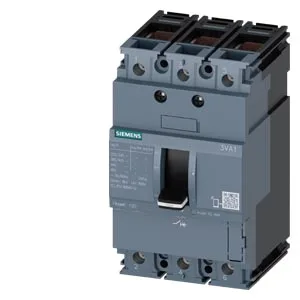
Its TM210 thermal-magnetic release handles overloads and short circuits without needing an external trip unit — so it's a self-contained protector for branch circuits feeding motor control centers, lighting panels, or general power distribution. The interrupting ratings climb to 75.6 kA at 240 V and 52.5 kA at 415 V, which gives you headroom for high-fault installations like transformer secondaries or large busway feeds.
At 55 °C it drops to 19.2 A, and at 70 °C it's 18 A. That thermal curve matters if you're packing breakers tight in a non-ventilated enclosure; you can still count on 18 A at the upper ambient limit. The interrupting ratings are given at four voltages: 75.6 kA at 240 V, 52.5 kA at 415 V, 32 kA at 440 V, and 7.5 kA at 690 V. For a 480 V panel you'd use the 440 V figure (32 kA) as the closest conservative guide — that's enough to clear a fault downstream of a large transformer without the breaker welding shut. The TM210 release is fixed, so you set the thermal pickup via the dial and the magnetic trip is factory-calibrated; no separate trip unit to order.
Built-in undervoltage release and auxiliary contacts
It also carries 2 auxiliary switches (HQ type) for remote status indication — you can wire those to a PLC input to know whether the breaker is open or closed without walking the panel.