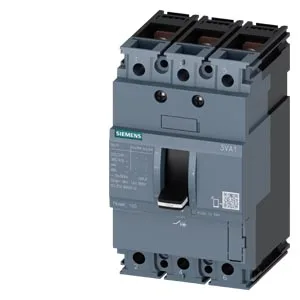
It's rated 32 A continuously at 40 °C ambient, and the thermal derating curve holds that 32 A all the way up to 50 °C; above that it drops to 31 A at 55–60 °C and 30 A at 65–70 °C. Breaking capacity is the other headline: 75.6 kA at 240 V, 52.5 kA at 415 V, 32 kA at 440 V, and 7.5 kA at both 500 V and 690 V.
Panel fit and physical integration
The footprint is 76.2 mm wide (3 in), 130 mm tall (5.12 in), and 70 mm deep (2.76 in). Three poles in a single compact block — no ganging required. Maximum power loss is 10.6 W.
Auxiliary and release configuration
The trip alarm switch gives a separate signal when the breaker trips on fault — useful for remote annunciation or a PLC input that triggers a shutdown sequence. The shunt trip lets you remotely open the breaker via a control voltage, which is common in emergency-stop circuits or fire-alarm interlocks. No undervoltage release on this build, so it won't drop out on a sag; that's a deliberate choice for processes that ride through dips. A voltage trigger indicator is present, and a mechanical trip indicator flags a fault locally. No communication function or ground-fault monitoring on this unit — it's a straight line-protection breaker with auxiliary signaling.