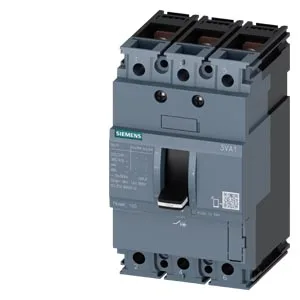
It's configured for line protection — no undervoltage release, no ground-fault module, no communication — so it's a straight thermal-magnetic breaker for branch-circuit or feeder protection in a 400 V class panel. The TM210 release is fixed-trip, not adjustable, which simplifies coordination: what you see is what you get. Breaking capacity runs 75.6 kA at 240 V, 52.5 kA at 415 V, 32 kA at 440 V, and 7.5 kA at 690 V.
Temperature derating and ambient limits
The 32 A rating holds up to 50 °C ambient without derating. At 55 °C it steps to 30.72 A, at 60 °C to 30.08 A, at 65 °C to 29.44 A, and at 70 °C to 28.8 A. That's a gentle slope — about 0.1 A per °C above 50 °C — so it still carries nearly 29 A at the maximum 70 °C operating ambient.
Auxiliary contacts and trip indication
The trip alarm is mechanically linked to the fault-trip mechanism — it changes state only on an overcurrent or short-circuit trip, not on manual open. That gives the control system a hard-wired fault signal without needing a separate undervoltage release or shunt trip. The auxiliary switch tracks the main contact position for status feedback.