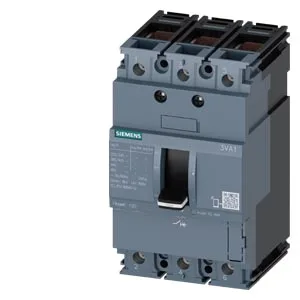
Its 50 A continuous rating at 40 °C holds flat through 50 °C, then derates to 45 A at 70 °C. The 3-pole design handles three-phase circuits, and the TM210 overcurrent release gives a fixed thermal-magnetic trip — no field-adjustable dials, so selectivity is set at the factory. Breaking capacity climbs as voltage drops: 52.5 kA at 240 V, 32 kA at 415 V, 13.6 kA at 440 V, and 7.5 kA at both 500 V and 690 V. For a 415 V distribution board, the 32 kA figure gives solid headroom against most utility fault levels. Maximum power loss is 14.6 W — not negligible in a sealed panel; factor that into thermal calculations if you're stacking breakers tight.
Auxiliary release and panel integration
The supplied basic switch is 3VA10502ED360AA0, which is the internal switching mechanism. Panel footprint is 70 mm deep, 76.2 mm wide, 130 mm tall — standard 3-pole MCCB width for the SENTRON 3VA platform, so it lands in the same DIN-rail or mounting-plate slot as other 3VA frame sizes. No communication function and no trip indicator — this is a plain thermal-magnetic breaker with a remote-trip coil, not a metering or smart breaker.