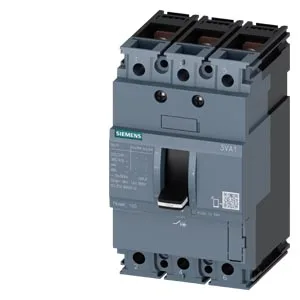
MCCB for line protection — 50 A, 3-pole, TM210 release
The Siemens SENTRON 3VA1050-4ED32-0AA0 is a 3-pole molded case circuit breaker rated 50 A continuous, fitted with a TM210 thermal-magnetic overcurrent release. It is designated for line protection duty — meaning it guards feeders and distribution circuits against overload and short-circuit faults, not motor branch circuits where a separate overload relay would be required. The interrupting ratings are the headline spec here: 121 kA at 240 V AC, 75.6 kA at 415 V AC, 52.5 kA at 440 V AC, and 11.9 kA at both 500 V and 690 V AC. At 415 V — the most common industrial distribution voltage — the 75.6 kA SCCR means this breaker can safely clear a fault up to that level without rupturing or cascading upstream, which is critical for panel coordination studies. Current rating holds flat at 50 A from 40 °C through 50 °C ambient, then derates to 49 A at 55 °C, 48 A at 60 °C, 46 A at 65 °C, and 45 A at 70 °C. That flat plateau up to 50 °C is useful — many MCCBs start derating at 40 °C, so this one gives a bit more headroom in a warm panel before you have to oversize.
Physical fit and panel integration
Dimensions: 130 mm height, 76.2 mm width, 70 mm depth. The 76.2 mm width is standard for a 3-pole SENTRON 3VA frame. Front-face protection is IP40 — protected against tools and wires over 1 mm, but not sealed against water ingress. This is normal for panel-mounted breakers; the IP40 rating means it's suitable for indoor switchgear and distribution boards where the enclosure provides the outer environmental seal.
Key ratings and what they mean for your BOM
Rated insulation voltage is 800 V, and the maximum operating voltage is 690 V AC — so this breaker is rated for 690 V systems (common in mining, oil and gas, and European industrial plants) and has insulation headroom above that. Maximum power loss is 14.6 W at rated current. That's a thermal budget number for panel cooling calculations — if you're packing multiple breakers in a small enclosure, the cumulative heat load matters for derating and ventilation. No trip indicator, no undervoltage release, no communication function, and no ground-fault monitoring on this variant. It is a straight thermal-magnetic line-protection breaker — no auxiliary electronics. If you need shunt trip, UVR, or ground-fault signaling, you need a different suffix on the order code.
