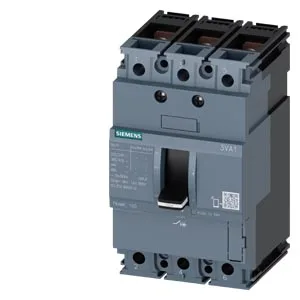
Siemens 3VA1050-4ED32-0AH0 — 50 A MCCB, TM210 Release, 3-Pole
The Siemens SENTRON 3VA1050-4ED32-0AH0 is a 3-pole molded case circuit breaker rated for 50 A continuous current at 40 °C, with a TM210 thermal-magnetic trip unit. It carries a breaking capacity of 121 kA at 240 V AC, 75.6 kA at 415 V, 52.5 kA at 440 V, and 11.9 kA at 690 V — the high 240 V figure makes this a strong candidate for 277/480 V panelboards where fault current runs high on the low-voltage side.
The 50 A rating holds flat from 40 °C through 50 °C (–), then derates linearly to 45 A at 70 °C. That means in a warm panel — say 55 °C ambient — you still get 48 A continuous, so the breaker doesn't nuisance-trip on a 45 A continuous load. Breaking capacity varies sharply with voltage: 121 kA at 240 V drops to 75.6 kA at 415 V and 52.5 kA at 440 V. At 690 V it's 11.9 kA — enough for most 690 V industrial loads but not for high-fault utility tie points. For a 480 V panel with an available fault current of 65 kA, this breaker clears it with headroom. That gives you two N.O./N.C. sets for status feedback plus a dedicated alarm contact that only changes state on a trip — useful for remote annunciation without wiring through the aux contacts.
Where It Goes — Panel Fit and Environment
This MCCB mounts in a standard distribution panel or motor control center. Dimensions are 130 mm high, 76.2 mm wide, 70 mm deep (–) — fits the same footprint as other 3VA 3-pole frames.