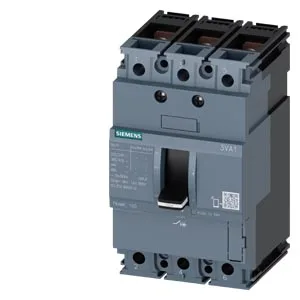
It's configured for line protection — the standard role for a feeder or main breaker in a distribution panel — and carries four auxiliary switches (HQ type) for remote status indication. The interrupting ratings climb to 75.6 kA at 240 V and 52.5 kA at 415 V, which covers most industrial service-entrance and sub-feed applications where fault current runs high.
Above that it steps down: 60.48 A at 55 °C, 59.22 A at 60 °C, 57.96 A at 65 °C, and 56.7 A at 70 °C. If your enclosure sits near a heat source or in a non-conditioned space, check the ambient at the breaker's location, not the room thermostat. Interrupting capacity varies sharply with line voltage: 75.6 kA at 240 V, 52.5 kA at 415 V, 32 kA at 440 V, and 7.5 kA at 690 V. On a 480 V wye service (277/480) the 440 V figure is the closest published point — 32 kA — which is adequate for most North American industrial panels. The 690 V number is low; if your system runs 600 V or 690 V, verify the available fault current stays under 7.5 kA or step up to a higher-rated frame.
The 3VA1063-3ED32-0AE0 measures 76.2 mm wide, 130 mm tall, and 70 mm deep — a standard MCCB footprint that fits most DIN-rail or panel-mount enclosures without re-drilling. The 15 000 mechanical endurance cycles is typical for a distribution breaker — fine for infrequent switching, not rated for daily motor-start duty.