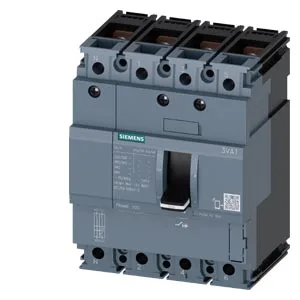
At 240 V it interrupts 75.6 kA, at 415 V it handles 52.5 kA, and at 440 V it clears 32 kA — numbers that tell you this breaker is sized for high-fault panels where a standard MCB would weld shut. The 800 V rated insulation voltage (Ui) gives headroom for 690 V line-to-line systems, though the interrupting rating at 690 V drops to 7.5 kA, so verify the available fault current if you're pushing that voltage class. It does not have a voltage trip, phase-failure detection, ground-fault monitoring, or any communication module — it's a straightforward line-protection breaker, not a multifunction power monitor. Dimensions are 70 mm deep, 101.6 mm wide, and 130 mm tall — a 4-pole footprint that fits standard SENTRON mounting rails.
Thermal derating — the real-world current you can actually run
At 55 °C it derates to 60.48 A, at 60 °C to 59.22 A, at 65 °C to 57.96 A, and at 70 °C to 56.7 A. If your panel ambient sits above 50 °C — say a sealed enclosure near a furnace line — you lose roughly 0.6 A per degree. Plan the load accordingly; the breaker won't trip early, but you'll be running it above its calibrated thermal curve.
What the TM210 release means for coordination
The TM210 designation indicates a thermal-magnetic release with a fixed thermal pickup and a magnetic short-circuit trip set at 10× Iu (630 A). That's a standard curve for motor-circuit or distribution feeders where you want the magnetic element to ignore inrush and only clear hard faults. For selective coordination downstream, pair it with a breaker whose instantaneous trip is below 630 A; upstream, ensure your main has a higher magnetic pickup or a short-time delay.