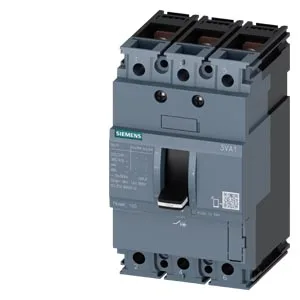
What this MCCB delivers on the line
The Siemens 3VA1080-4ED32-0DC0 is a SENTRON molded case circuit breaker (MCCB) rated for line protection in 3-pole, 80 A service at 40 °C ambient. It carries a 121 kA interrupting rating at 240 V AC — enough to handle high-fault utility feeds without cascading upstream — and still delivers 75.6 kA at 415 V AC, 52.5 kA at 440 V AC, and 11.9 kA at 500 or 690 V AC. That voltage-versus-current curve tells you this breaker is sized for low-voltage distribution where available fault current is substantial, not for a lightly loaded subpanel. Rated insulation voltage is 800 V, so the internal clearances and creepage are designed for 690 V phase-to-phase systems without derating the dielectric. Power loss at full load runs 21.7 W maximum — a number to factor into enclosure thermal calculations if the panel is tightly packed.
Thermal derating and continuous current
The 80 A rating holds flat from 40 °C through 50 °C. Above that it steps down: 78 A at 55 °C, 77 A at 60 °C, 75 A at 65 °C, and 74 A at 70 °C. If your panel ambient runs 60 °C, you lose only 3 A — about 4% — which is better than many MCCBs in this frame size. The operating range is -25 °C to +70 °C, storage from -40 °C to +80 °C.
Built-in auxiliary and undervoltage release
This variant ships with an undervoltage release (UVR) factory-fitted — the release trips the breaker when control voltage drops below a threshold, which is standard for safety circuits or emergency-stop chains that need to drop the main breaker on loss of control power. It also includes two HQ auxiliary switches for remote status indication (open/closed/tripped). No ground-fault monitoring module is included; this is a straight line-protection breaker.
Footprint and panel fit
Dimensions are 130 mm high, 76.2 mm wide, 70 mm deep. The 76.2 mm width (3 inches) is standard for a 3-pole MCCB in this frame class — it fits the same mounting footprint as other SENTRON 3VA breakers, so swapping between ratings in the same panel is a direct mechanical exchange without drilling new holes or moving the DIN rail.
